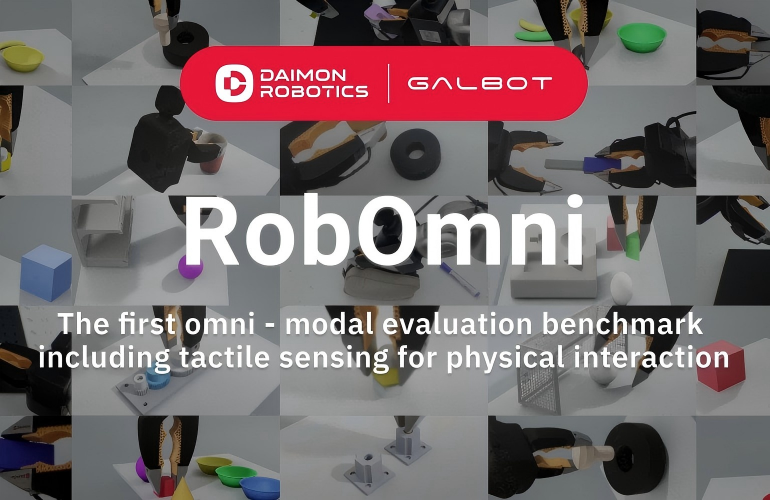
Daimon Robotics Launches RobOmni Benchmark for Tactile Perception at ICRA 2026
Embodied AI is evolving from vision-centric perception toward Physical AI. While vision enables robots to perceive the world, it cannot fully capture the physical interactions that underpin real-world manipulation, limiting robots’ ability to operate reliably in unstructured environments.
As World Models advance, tactile sensing is increasingly recognized as a key modality. By providing critical physical feedback beyond vision, tactile helps robots understand and interact with the physical world, making it an essential foundation for intelligent manipulation. Yet one critical question remains difficult to answer: How much does tactile sensing actually improve physical interaction? In what ways does it improve robot manipulation? What kinds of tactile data are most needed for physical AI? While many robotics developers believe tactile will play an important role in the next generation of embodied intelligence, the industry lacks a standardized way to evaluate its impact. Without unified benchmarks, it remains challenging to compare systems, measure progress, or determine which tactile perception deliver meaningful improvements in real-world tasks. To address this challenge, Daimon Robotics has launched RobOmni at ICRA2026, the first omni-modal evaluation benchmark including tactile sensing for physical interaction. Why tactile matters Many real-world robotic applications require more than vision alone. Tasks such as grasping, insertion, assembly, object placement, and tool handling depend heavily on physical interaction. During these operations, robots must continuously interpret contact conditions and adapt their actions accordingly. Humans naturally rely on tactile to determine whether an object is slipping, how much force is being applied, whether a material is soft or rigid, and how components fit together during assembly. Replicating these capabilities remains one of robotics’ most significant challenges. Daimon Robotics, an embodied intelligence company from Hong Kong focused on tactile perception and dexterous manipulation, refers to its approach as “omni-modal tactile intelligence”. Its self-developed vision-based tactile sensors are designed to capture multidimensional tactile information at high frequency and high resolution.