Intermittent swimming promotes the energy efficiency of fish-like robot movements
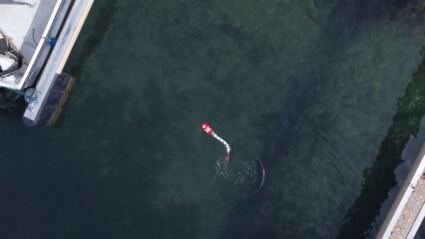
Figure — image credits: Xiangxiao Liu, Francois A. Longchamp, and Louis GeverBiorobotics Laboratory, EPFL Improving energy performance can effectively extend the time a robot can operate and reduce battery load, enabling lighter, more flexible, and more durable robotic systems.
Nature has evolved optimal energy-saving locomotion strategies through billions of years of natural selection, providing unparalleled blueprints for robotic optimization. Among diverse modes of aquatic locomotion, intermittent swimming, also called bout-and-glide swimming, is a widespread adaptive behavior in aquatic organisms of a wide range of sizes, including larval zebrafish, red-nose tetra, koi carp, and even whales. This natural bout-and-glide gait features alternating motion phases: short periods of active body and tail undulation for propulsion, followed by passive gliding with a streamlined, straight body posture. It is widely recognized that this intermittent swimming gait is closely associated with optimizing biological energy, making it of great research value to transplant and explore such natural motion mechanisms into robotic control systems. In this study, an international joint team comprising researchers from EPFL (Switzerland), Duke University (USA), and Instituto Superior Tecnico (Portugal) developed a larval zebrafish-inspired robotic platform (ZBot) to systematically investigate the intrinsic characteristics and performance advantages of bout-and-glide intermittent swimming compared to continuous swimming. This research focused on four scientific questions: 1. Which neural control mechanism underlies intermittent swimming locomotion? To validate the bioinspired energy-saving mechanism of fish intermittent swimming, the team developed a biomimetic robot, ZBot (Figure 1), scaled up 200 times from a larval zebrafish, with a body length of 80 cm and a weight of 2.8 kg. The ZBot replicates the larval zebrafish’s morphological features, segmented body structure, and center-of-mass distribution. Its flexible tail consists of six servomotor-driven segments to simulate natural fish undulation, while the head integrates core devices, including a central controller that serves as its nervous system, high-precision cameras, and real-time power meters. Equipped with expandable sensor interfaces, ZBot supports diverse experimental needs, including visual-motor processing [2] and vestibular system research. Figure 1. ZBot and real larval zebrafish. 2. Can intermittent bout-and-glide swimming achieve higher energy efficiency than continuous tail-beating swimming, and if so, under which conditions?