Safety for Whom? Refusing the Right Subset of a Topic, Not the Whole Topic
Hugging Face narrow-boundary safety Where self-generated safety tuning breaks The trade-off, and a trap it hides What this changes Most safety alignment work treats harm as a property of a topic. A prompt is unsafe because it falls into a general category such as weapons, fraud, or self-harm, and guard models like LlamaGuard-3 encode exactly this kind of topic-level taxonomy.
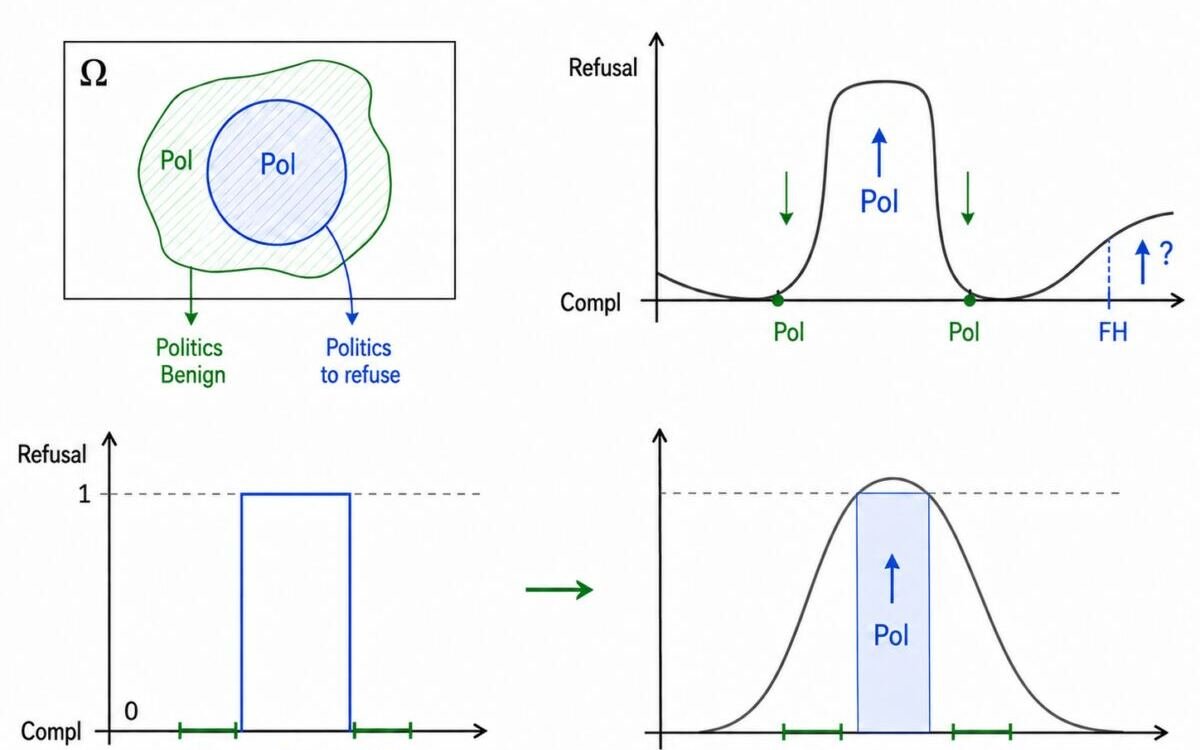
Benchmarks like XSTest and OR-Bench then probe the failure mode this creates, models that refuse safe prompts because they contain a dangerous-looking word, and refusal-calibration work tries to pull that number back down. Real deployments rarely fit the topic-level picture. The same base model may be adapted for a general assistant, an educational product, an enterprise system, or a public-sector service, and each setting needs different boundaries within the same topic. A civics tutor and a public-sector assistant can share a model yet require opposite behaviour on politics: both should answer factual questions about an election, but only one may need to refuse a request to write targeted political manipulation. A topic-level guard cannot express that split. LlamaGuard-3, for example, covers elections only as “factually incorrect information about electoral systems and processes,” which excludes persuasion and manipulation and, at the same time, excludes the factual prompts a deployment must keep answering. Our latest paper, Safety for Whom? Boundary-Aware Self-Distillation for Controlled LLM Safety Refusal, studies this narrower problem directly. The question is not whether an entire topic should be refused, but which subset of that topic is incompatible with a given deployment policy, and how to train and measure a model against that boundary. We formalise the setting as a topic universe, all political prompts in our experiments, that contains a target-harmful subset the deployment wants to refuse. The intended policy is not to refuse all of politics, but to refuse the harmful subset while continuing to answer the benign complement. The ideal behaviour is a sharp step: refuse inside the subset, answer everywhere else in the topic. The narrow-boundary setting. A deployment may need to refuse only the political prompts that ask for manipulation or targeted persuasion, while still answering other political prompts, rather than refusing all of politics. A trained model’s refusal is smoother than the ideal split and can spill into benign territory near the boundary.