Rebuilding AUTOMATIC1111 with Gradio Workflow
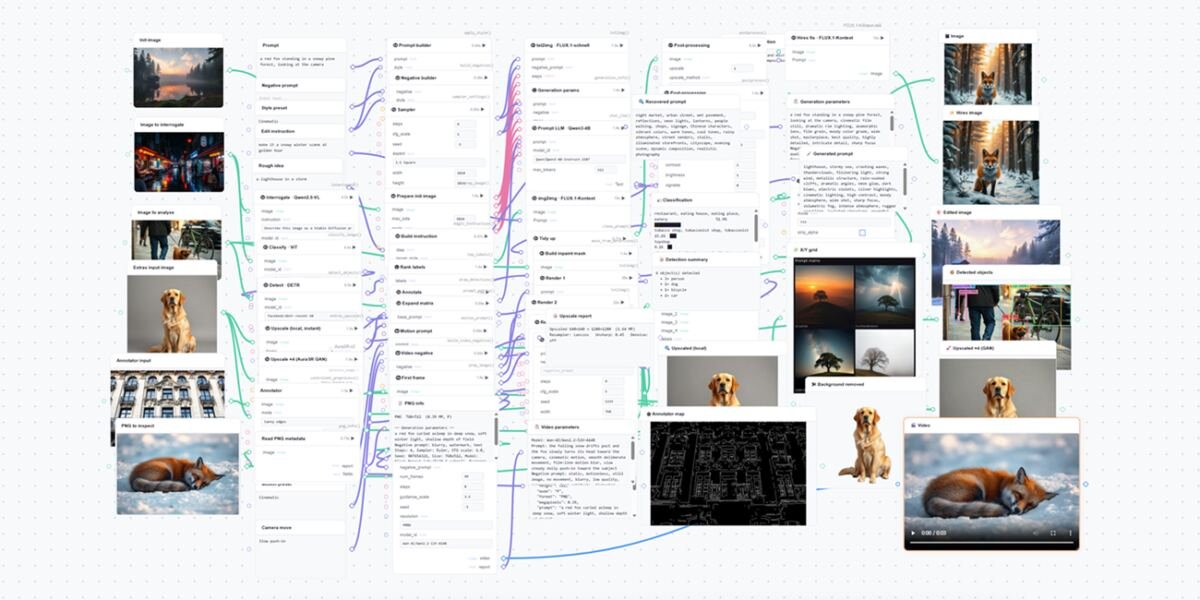
Hugging Face what's on the canvas Text-to-image Hi-resolution fix Image-to-image Let an LLM write the prompt Let an LLM write the prompt Read an image back into a prompt Detection to inpaint mask Prompt matrix Upscale and background removal Annotators PNG Info Image-to-video Running models on your own GPU Every output is an API Where this sits next to ComfyUI Build your own In our last post, we built five small gr.Workflow graphs and hinted at what it would take to build something as complex as AUTOMATIC1111’s stable-diffusion-webui. In this post we walk you through Workflow1111, where we have rebuilt most of AUTOMATIC1111’s feature set as a single workflow canvas.
Workflow1111 is a graph of eleven media pipelines built using seventy-three nodes. It brings together SOTA models for text-to-image, hi-resolution fix, image-to-image, prompt-matrix grids, VLM interrogate, detection-to-inpaint masks, ControlNet-style annotators, background removal, PNG Info storing, and image-to-video. You can run any of these pipelines by signing in with your Hugging Face account or providing an access token. Once you sign in, the model calls use your own quota. 👉 Try Workflow1111, or duplicate the Space and start rewiring it for your own use case. All the media pipelines are built from the same four operator kinds covered in our last post and the official guide. Each node on the canvas wraps one operator, and the operator’s inputs and outputs become the ports you connect edges to. As a quick reference on our four operator kinds: fn is a Python function, model is a model called through InferenceClient, space is another Gradio Space, and dataset is a row from a Hub dataset. This is the core pipeline. It has the controls you’d expect from A1111’s txt2img tab: negative prompt, steps, CFG, seed, width and height, plus a model_id field for choosing the checkpoint. The prompt goes through a prompt-builder fn node first, which appends the selected style preset and cleans up the text, then into a model node that calls the checkpoint through Inference Providers. A post-process fn node writes the generation parameters into the PNG’s metadata on the way out, which is what the PNG Info pipeline reads back later. In Automatic1111, hi-resolution fix first upscales the txt2img output and then runs a second denoising pass. Here it’s a two-node detour instead. The text-to-image result goes into a FLUX.1-Kontext model node with a refine instruction (“enhance fine detail and micro-texture, keep the composition identical”) and comes back sharper and larger.