Icarus Robotics flies ISS-bound robot in microgravity for the first time
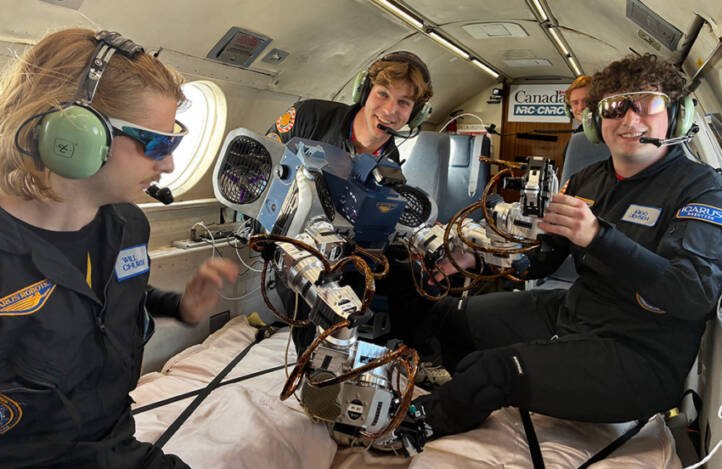
NVIDIA Corp. — icarus co-founder and CTO Jaime Palmer (center) with the Icarus team testing Joy on a parabolic flight. | 9 to 11.
In total, Joy flew 66 parabolas across four flights, resulting in 2 cumulative minutes of weightlessness. Joy is a free-flying robot with robotic arms and finger pinch grippers. Icarus created the system to move through the pressurized interior of the International Space Station (ISS) and handle the cargo and logistics work that consumes much of astronauts’ time. The company said its robot will be launched to the ISS in 2027 as Joyride-1, under a mission management agreement with Voyager Technologies announced in March. The flights were the last major test before Icarus finalizes Joy’s flight hardware for handover to NASA in January. “It’s a very surreal thing to be building toward that, and we have been talking about it for over a year,” Ethan Barajas, co-founder and CEO of Icarus Robotics, told The Robot Report. “Now we have the confidence to go into January and say that this robot that we will hand over to NASA will operate in the way that we want in microgravity on the ISS.” “We had stretch goals, and we had minimal viable success criteria,” he added. “Throughout this entire week, we hit all of those.” Icarus Robotics’ stated goal is to free up astronauts so they can focus on higher-value research and mission objectives. Last year, the Brooklyn, N.Y.-based startup raised $6.1 million in seed funding. Since then, it has worked to turn its system into a scalable, production-ready robot. Icarus Robotics tests three core systems in Joy https://www.therobotreport.com/wp-content/uploads/2026/09/Icarus-Robotics.mp4 Parabolic flight is the only way to produce real microgravity without going to orbit. During these flights, the aircraft arcs over the top of a steep climb, giving everything inside roughly 20 seconds of weightlessness per parabola. Icarus Robotics said it focused on testing three major systems within Joy: its manipulation, state estimation, and flight control. “We had essentially four flights across the week, and then we chose to isolate different systems across the different flights. About half of our campaign was based around essentially testing the manipulation system,” explained Jamie Palmer, co-founder and chief technology officer of Icarus.