Pruning LLMs Like a Physicist: Block Removal as an Ising Optimization Problem
Hugging Face why picking blocks is a many-body problem The idea: turn block selection into an energy-minimization problem Solving it: exact when you can, quantum or quantum-inspired when you can't Why the whole low-energy spectrum matters Results It generalizes beyond dense transformers Why this fits Multiverse Computing One of the cheapest ways to make a large language model faster is also one of the bluntest: delete whole transformer blocks. Because the model literally gets shorter, block removal (also called depth pruning) buys predictable inference speedups on top of the memory savings, and it stacks cleanly with quantization, low-rank compression, and other techniques.
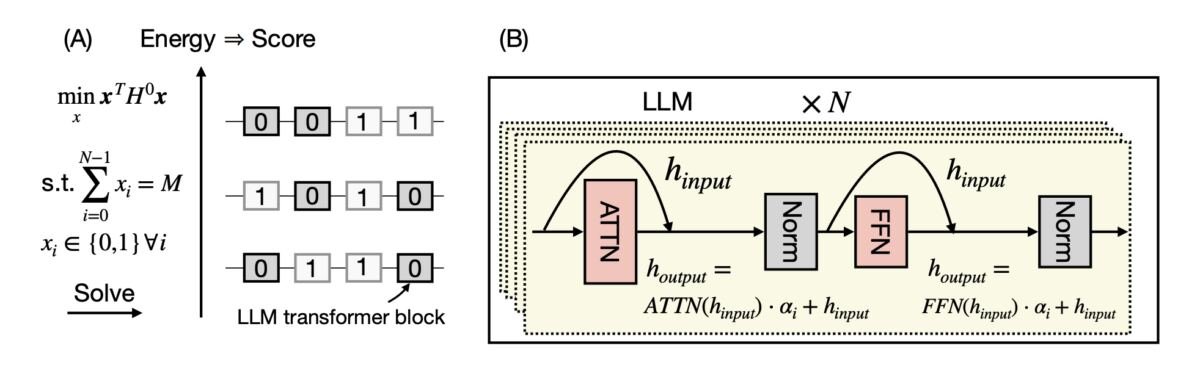
The hard part is deciding which blocks to cut. Remove the wrong ones and the model collapses; and the effect of removing any one block depends on which others you remove alongside it, so the choices interact. That makes it a combinatorial problem, not a ranking problem, and combinatorial problems with interacting binary variables are exactly what the physics of spin systems was built to describe. Our latest paper, LLM Compression by Block Removal with Constrained Binary Optimization, takes that correspondence literally. We reformulate block selection as a constrained binary optimization (CBO) problem that maps directly onto an Ising glass, a disordered spin system with all-to-all interactions and a fixed number of “up” spins. The energy of that spin system turns out to be a strong, cheap proxy for how well the pruned model will actually score on benchmarks, which means we can rank a huge number of candidate configurations without benchmarking any of them, and hand the hard instances to the same classical and quantum-inspired solvers we use elsewhere at Multiverse. The payoff in the deep-compression regime is large: at 50% compression of Llama-3.3-70B-Instruct, we gain almost 23 percentage points on MMLU over the best competing block-removal method. Most existing block-removal methods score each block on its own, then remove the ones that look least important, using magnitude, sensitivity, or “block influence” heuristics. In physics terms these are mean-field methods: they treat each block as if its contribution were independent of the others, the way mean-field theory replaces a spin’s neighbors with a single averaged field. A related shortcut is to only ever remove a single consecutive run of blocks, which keeps the problem small but throws away most of the search space. The trouble is that blocks are not independent, any more than spins in a real magnet are. Whether removing block 20 hurts the model depends on whether you also removed block 19 or block 24, an interaction, or coupling, between the two decisions. As models get deeper and more heterogeneous, ignoring those couplings leaves quality on the table, especially when you want to remove a lot of blocks at once. What you really want is to search over combinations of blocks while accounting for how they interact, but the number of combinations grows exponentially, so brute force looks hopeless. This is precisely the regime, exponentially large configuration spaces with pairwise couplings, where the tools of statistical physics earn their keep.