New USFP Pluggable Optics Form Factor for Higher Speeds from Cisco and NVIDIA
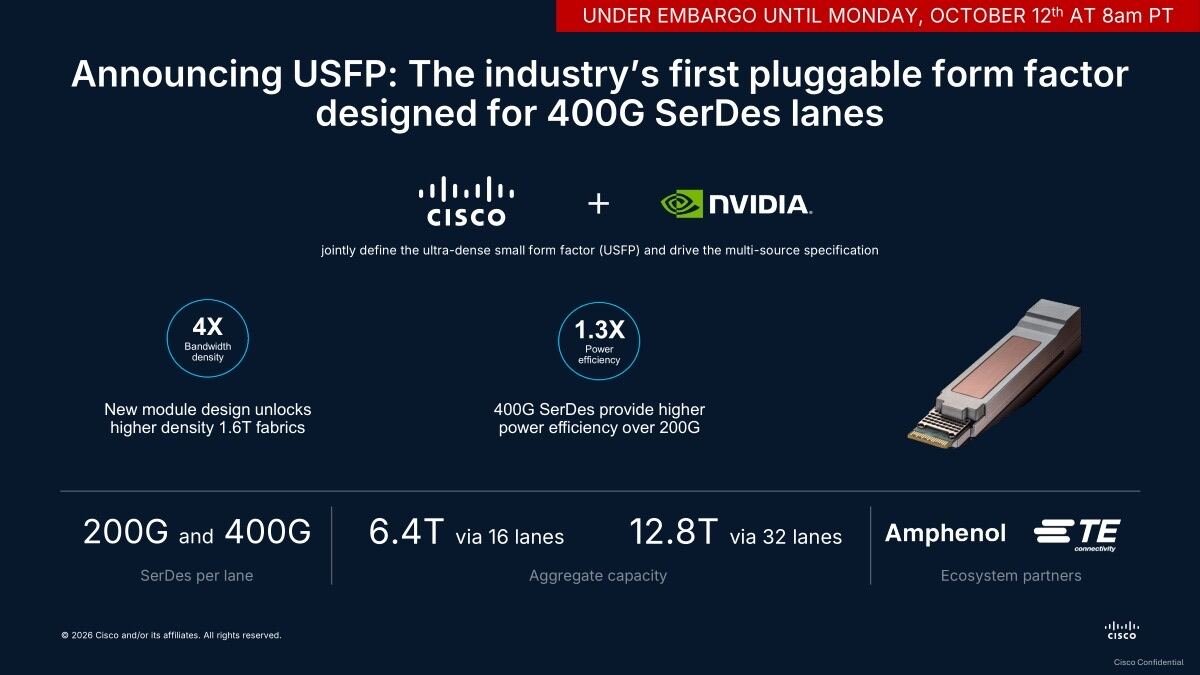
Ahead of the OCP Global Summit, Cisco briefed analysts on AI-infrastructure announcements spanning optics, silicon, systems, and software. For us, the headline is clearly the ultra-dense small form factor, or USFP, a pluggable module Cisco developed with NVIDIA for 400G SerDes lanes, which it says enabling higher-density 1.6Tbps fabrics.
Cisco also detailed the Silicon One G300 in first systems, a G302 front-end top-of-rack switch coming in Q4 2026, and the Silicon One A100L aimed at lower-cost 10G/1G out-of-band management switches. USFP will be a big one with both Cisco and NVIDIA behind it and because next-generation pluggable optics are a key part of the 1.6Tbps Ethernet generation. To me, the A100L stood out on the briefing call since Cisco’s custom silicon applied to cost-sensitive switching rather than only the high-performance fabric. Cisco and NVIDIA are designing a new pluggable form factor for 400G SerDes lanes rather than today’s common 200G lanes. We will say “common” because there is still a lot of 56G PAM4 SerDes and 112G gear being sold today. Moving to 400G means 1.6Tbps networking can happen on four lanes, scaling to 6.4T aggregate across 16 lanes and 12.8T across 32. Cisco and NVIDIA are jointly drafting the multi-source specification so other vendors can build to it. It is interesting that QSFP/ OSFP were not sufficient for the next-gen speeds. Pairing that optics work with switch silicon produces the ethernet-to-optical architecture on the next figure, which places the Silicon One G300 in first-shipped Cisco 8000 and N9000 systems at 102.4T of capacity across 1.6T ports. Now, the new G302 drives a 51.2T front-end top-of-rack switch using 200G SerDes. The Silcon One A100L made me ask a question at the analyst pre-brief. Custom AI silicon usually appears in high-performance fabric switches since that is where the value from doing something custom often can be captured. Lower-end silicon found in management boxes running the 1G/10G networks in racks tends to be mostly just a volume play. Cisco said it was proof the architecture scales and hyperscale clients wanted to run SONiC on everything. I asked what the licensing model would be, more perpetual like a C1300 or more like the Nexus 9K series but did not get a clear answer on that one so I am going to call it a TBD.