Award-Winning Researcher Trains Robots to Make Educated Guesses
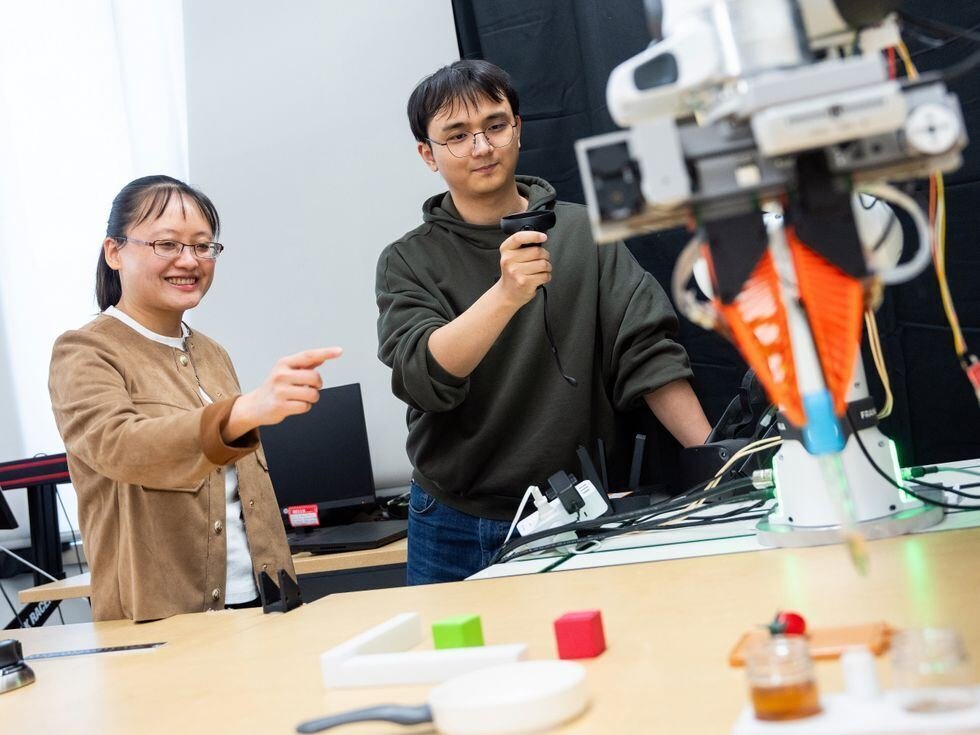
Yen-Ling Kuo always wanted to understand how things worked. When she was growing up in Taiwan, reading the story of Michael Faraday in elementary school piqued her curiosity about the natural world.
During that time, she was introduced to Logo, a computer program with a turtle cursor to help children learn basic coding through hands-on experimentation.It was Kuo’s introduction to programming logic.Yen-Ling KuoEmployerUniversity of Virginia in CharlottesvilleTitleAssistant professor of computer science Member gradeMemberAlma matersNational Taiwan University; MITIn high school she learned the capacity computers held. She could write programs that completed tasks independently, she realized.“Once I discovered how powerful computers could be,” she says, “I knew I wanted to focus on using them to solve real-world problems.”Kuo, an IEEE member, never lost her interest in the “how” behind processes and tools. Her curiosity, combined with a stint working at a Silicon Valley company, led her to focus on innovations that live at the intersection of cognitive and computer sciences. Kuo, now an assistant professor of computer science at the University of Virginia in Charlottesville, last year received the IEEE Robotics and Automation Society’s inaugural Outstanding Women in Robotics and Automation Early Career Contribution Award. The award is part of the IEEE-RAS Women in Engineering’s Outstanding Women in Robotics and Automation (WiRA) Paper Awards, which promote excellence and recognize the impact that female researchers have on robotics and automation fields at different stages in their academic careers.Kuo’s winning paper, “Diff-DAgger: Uncertainty Estimation with Diffusion Policy for Robotic Manipulation,” demonstrates a novel method to help robots better identify and estimate uncertainty when faced with scenarios on which they’ve not been trained. The method reduces the amount of human supervision, improves a robot’s rate of successful task completion, and opens up a path to introduce more complex models with bigger data demands into interactive robot learning.She says her research will help people working in the robotics and automation fields more efficiently collect the data needed for effective model training.Silicon Valley’s impactKuo earned bachelor’s and master’s degrees in computer science at the National Taiwan University, in Taipei, in 2009 and 2012. As she was nearing completion of her master’s degree, she did what many computer science graduates do: She pursued a summer internship at a tech company.She spent the summer of 2011 at Google’s campus in Kirkland, Wash., working on the company’s comparison ads project.When her internship ended, she joined the MIT Media Lab as a visiting student, working on the Open Mind Common Sense project with Henry Lieberman.As she was considering pursuing a Ph.D., a call from Google changed her plans. The company offered her a full-time role as a software engineer.“I viewed the job offer as a positive development,” she says. “I believe it can never hurt your future research career to get some real-world experience under your belt.”She was hired in 2012 and helped build techniques that incorporate computer vision and natural language processing to improve the customer shopping search experience. She led the company’s Shop the Look initiative, a predecessor to Google’s current AI-powered shopping experience. The project connected social media content with search results, something the company had struggled to do in the past.Kuo and her team were tasked with building a connection between the natural language people use to describe an item and an image that matches the searcher’s intent. It was at a time when the neural network—using deep learning models to power Google products—was gaining momentum at the company. Integrating neural network tools into her work was a requirement—which raised questions for Kuo.“I was applying the neural network tools,” she says. “But I didn’t have 100 percent certainty about how they actually worked.”She considered how she could become more knowledgeable about deep learning models. It was a full-circle moment.