NVIDIA Cosmos3-H-Dreams: Bringing Clinical Surgery to Life Through Generative Simulation
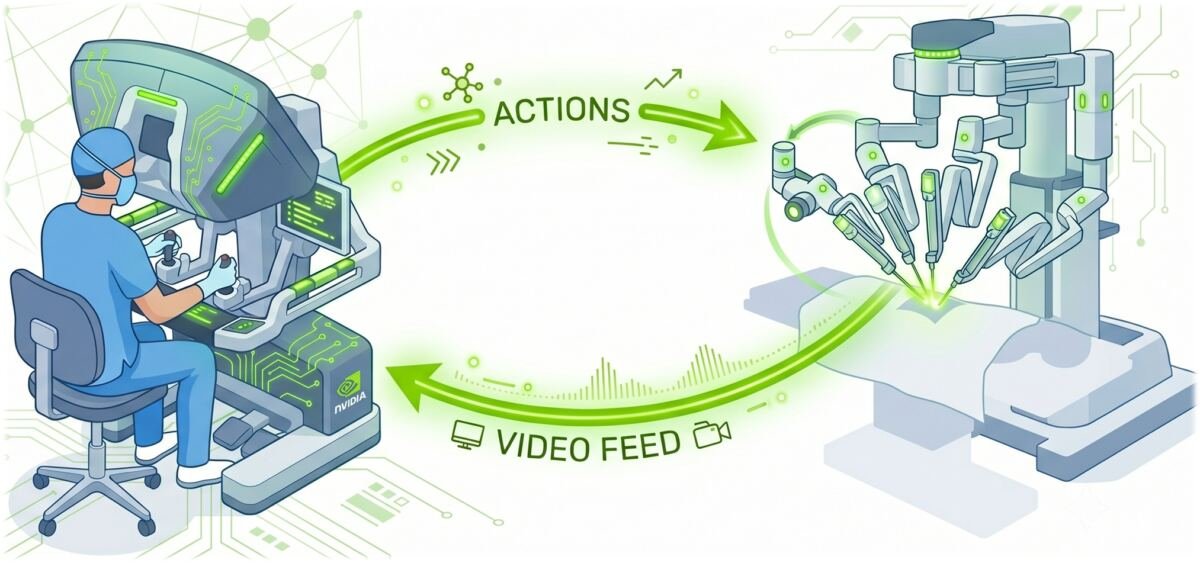
Hugging Face 1. From Tabletop Tasks to Clinical Scenes 2.
What is New in Cosmos3-H-Dreams? 2.1 A Cosmos 3 Foundation and Richer Surgical Controls 2.2 From Teacher to Four-Step and Two-Step Students 2.3 Streaming through FlashDreams 3. Exploring Unseen Trajectories 4. Adapting to Your Own Data and Controller 5. What is Next 6. Get Started Today Picture moving the Cadiere grasper, grasping the gallbladder, and lifting it, all within a generated surgical scene that responds in real time. Today, we take the next step and introduce Cosmos3-H-Dreams, bringing interactive generative simulation to the visual and procedural complexity of clinical surgery with our most convincing in-body imagery to date. Our first Cosmos-H-Dreams release, built on Cosmos-Predict2.5, brought interactive generative simulation to dVRK tabletop suturing, a foundational proving ground for surgical robotics. As world foundation model (WFM), Cosmos-H-Dreams demonstrated an alternative to numerical simulation: rather than explicitly modeling scene geometry, tissue deformation, and physical interactions, it learned visual dynamics directly from synchronized video and robot kinematics, yielding interactive tabletop task simulation with high realism. Today, Cosmos3-H-Dreams advances this capability by learning from video and robot kinematics recording during clinical procedures on the CMR Surgical Versius platform. To our knowledge, this is the first real-time generative surgical simulator trained on clinical cholecystectomy recordings to support live kinematic control. Powered by Cosmos 3 and accelerated with FlashDreams, NVIDIA’s accelerated streaming-inference library, Cosmos3-H-Dreams runs interactively on a single NVIDIA RTX PRO 6000 GPU. In a controlled tabletop environment like that of Cosmos-H-Dreams, instruments operate against a relatively simple background. Inside the human body, however, small instrument movements can affect an entire scene: tissue stretches under traction, reflections shift, structures become occluded, and smoke changes visibility. Given an initial image and supplied tool actions, a generative simulator must capture these responses while preserving the anatomy and instruments as it generates each new block of video.