Europe’s Industrial Leaders Reinvent Engineering and Manufacturing With NVIDIA
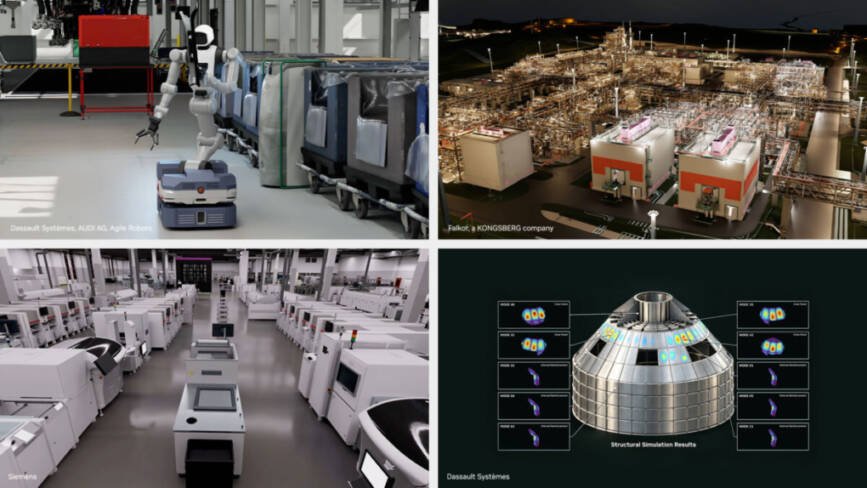
To increase productivity, accelerate innovation and create new opportunities for economic growth, Europe’s industrial leaders are tapping NVIDIA CUDA-X and Omniverse libraries, as well as NVIDIA Cosmos and Nemotron open models, across the engineering and manufacturing lifecycle. Bringing those capabilities together on the factory floor, the NVIDIA Factory Operations Blueprint (FOX) is now available in early access on GitHub, providing a path for developers to build and deploy always-on factory manager agents that coordinate work across machines, and specialist agents focused on use cases such as visual inspection, root cause analysis, report generation and fleet management. These agents can connect to frontier models, including NVIDIA Cosmos and Nemotron, and foundational knowledge including computer-aided design, product lifecycle management, simulation software, and IT and operational technology systems. Building on the FOX blueprint enables the ecosystem to build industrial agents that monitor factory operations in real time, correlate visual findings and machine logs to investigate problems, and coordinate responses.
With Cosmos in-context learning, these agents can adapt using examples and documentation, without fine-tuning. Siemens is integrating agents built using FOX into Intelligence Center X, its agentic enterprise system, to help identify root causes and coordinate factory operations, for estimated cost savings of 20%. Siemens’ Process Preparation X agents use NVIDIA Cosmos Data Factory tools and skills to generate defect images for circuit-board inspection. At its Erlangen electronics factory, Siemens used this approach to reduce calibration time of inspection processes by 40%. Read All NVIDIA in Europe Announcements Accelerating Engineering From the First Design NVIDIA CUDA-X libraries accelerate simulation, giving engineers faster feedback to explore design alternatives before committing to physical prototypes. At GTC Berlin, NVIDIA is releasing cuDSS for general availability, accelerating the demanding calculations behind the complex simulations of structural stress, fluid flow, electromagnetic fields and semiconductor device behavior. Mercedes-Benz uses Siemens’ Simcenter STAR-CCM+ running on NVIDIA GPUs to compare vehicle designs through faster aerodynamic simulations. In factories, the company applies NVIDIA Cosmos 3 and the Metropolis VSS blueprint to build agents for vehicle inspection and windshield assembly verification, detecting deviations and ensuring consistently high quality. Cadence is benchmarking automotive fluid-dynamics workloads on NVIDIA GPUs to assess opportunities for faster design iteration, while Autodesk brings the NVIDIA PhysicsNeMo and Warp frameworks into NavPack, integrated with Autodesk Alias, to help designers like those at Bentley’s predict vehicle performance and iterate faster using simulation-trained AI. imec and Infineon are accelerating semiconductor simulation with Synopsys software and NVIDIA accelerated computing. Benchmarks of S-Litho on imec’s model show up to 40x speedup, while Infineon uses Sentaurus Device with NVIDIA CUDA libraries to achieve a 12x speedup in 3D breakdown simulation for next-generation power devices. Leonardo is working with Neural Concept on AI-driven aircraft design, tapping NVIDIA Omniverse libraries to bring aircraft geometry and aerodynamic simulation results together. Video courtesy of Neural Concept and Leonardo. Car manufacturers use Dassault Systèmes’ LEO & AURA Virtual Companions, powered by NVIDIA Nemotron, and orchestrating CATIA AI Agents & SIMULIA AI Agents with SIMULIA solvers, accelerated by NVIDIA CUDA-X libraries, to rapidly design and virtually test vehicle doors before building physical prototypes. UniversalAGI is working with Saab to protect sailors from life-threatending wave impacts at sea, using UniversalAGI’s Latent Interaction Field Transformer physics AI foundation models with accelerated processing by NVIDIA Warp to evaluate thousands of wave conditions and headings in real time instead of days. These capabilities enable vessels to anticipate dangerous motion and autonomously select safer routes to avoid putting sailors at risk, while NVIDIA Omniverse libraries help visualize vessel behavior at sea.