Can Agentic Robotics Solve Robotics’ Data Scaling Problem?
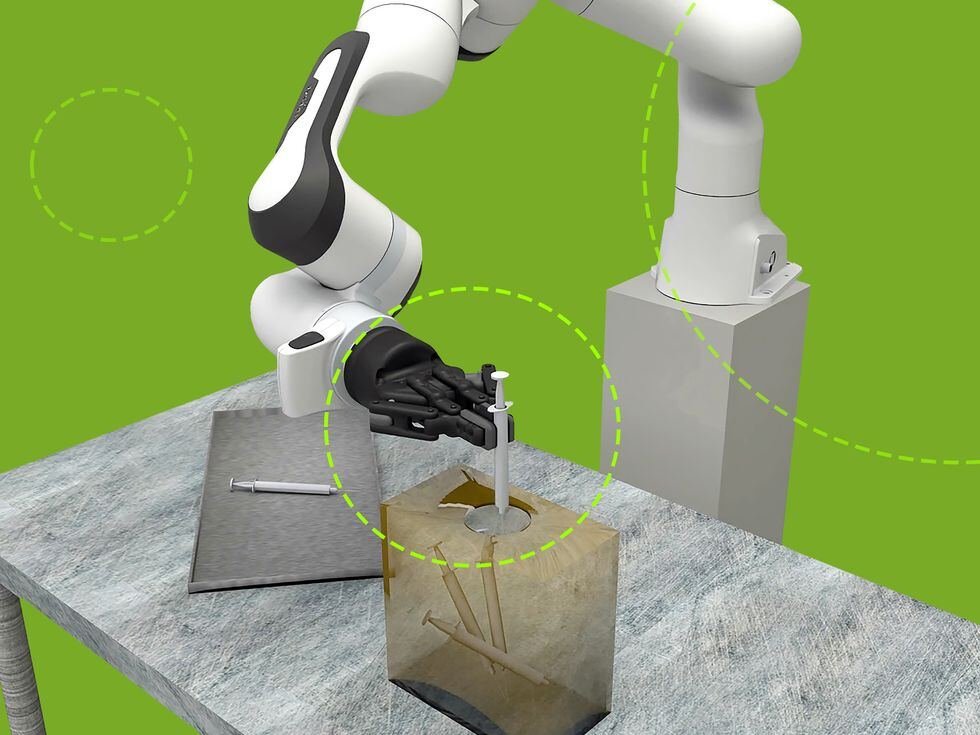
figure — aI agents use simulation to solve tough robotics problems with code, not data Evan Ackerman is IEEE Spectrum’s robotics editor. A 3D rendering shows an agentic robotic arm depositing used hypodermic needles into a disposal box.
The simulated task required that agents successfully navigate variable sub challenges, such as differently shaped disposal boxes. Robotics companies are investing heavily in the belief that data will solve the most difficult problems in robotics. Once AI systems have ingested enough data from human demonstrations, the thinking goes, robots will be able to perform the vast majority of the manual tasks that humans now do. There are even robotics companies that exist solely to collect training data and sell it to other robotics companies in pursuit of this goal. But whether data will finally bring us general-purpose robots is an open question. Nobody knows how much data would be necessary, what kind of data is important, or whether something else might be missing. And there are other problems with a reliance on massive amounts of data: the resulting AI algorithms are essentially black boxes, which despite their high performance are difficult or impossible for humans to understand. This characteristic is becoming increasingly concerning in commercial deployments, where robots must be flexible, reliable, and safe. At the 2026 Conference on Robot Learning this week, UC Berkeley and NVIDIA are jointly announcing a new approach to using AI to program robots for everyday practical tasks in industrial environments. Called agentic robotics, this technique leverages the latest advances in AI coding tools while in some sense bringing robotics back to its roots—achieving a fundamental understanding of how a robot works, and then writing human-readable code to get it to do useful things, no data (and no humans) required. For decades, robots were programmed with model-based methods, meaning that their behavior was based on a detailed understanding (or model) of the physics and mathematics underlying the robot and its environment. Roboticists would first develop these models, and then write painstakingly detailed code telling their robots how to act. The resulting hand-tuned robotic systems could operate fast and reliably, but this approach has fallen out of favor because it requires both human time and human expertise. It’s much easier to just feed a huge amount of human demonstration data into a machine-learning system, and the results that come out are both adaptable and reliable—up to a point. “The imitation learning paradigm has hit a plateau,” explains Ken Goldberg, a professor of robotics at UC Berkeley whose lab is presenting a paper on agentic robotics at this week’s conference.