The Secret to Marathon-Winning Humanoid Robots
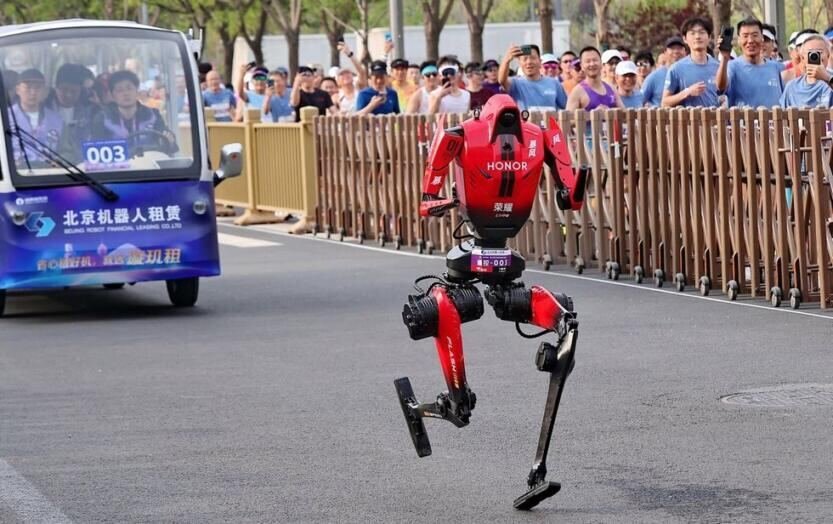
IEEE Spectrum Robotics — on April 19, 2026, the Honor Lightning humanoid robot ran a half-marathon in 50 minutes and 26 seconds, beating the human world record by 7 minutes and the best robot time from 2025 by almost two hours.How did they do it? Is there some magical technology or technique that unlocked this performance?
How did they beat the significantly better-known Unitree (who reportedly had to supply an ice backpack to try and complete the race without overheating)? My doctoral thesis involved building and controlling hopping and running robots, and since then I’ve tried to design and build efficient commercial legged robots, giving me a decent idea of the constraints involved. In this article, we take a look at the fundamental underlying constraints to try and answer these questions.The Physics of RunningRunning consists of alternating phases of a leg pushing against the ground (“stance phase”) and the body flying through the air (“aerial phase”). In the aerial phase, the body falls due to gravity, losing vertical momentum. The leg in stance phase pushes against the ground to redirect the vertical momentum upward, while the other leg swings forward to reposition for the next foothold.Electric motors use energy to produce torque- the higher the torque, the more energy lost as heat. Adding a geartrain after the motor amplifies its torque and reduces its speed. A large reduction helps with torque production, but since the rotor of the motor itself has to spin faster, it becomes very sluggish at accelerating its output. This is obviously bad for the swing phase described above. These competing effects mean that for a particular motor, there is usually a sweet spot for the gear ratio: The power consumed by a robot leg is minimized at an optimal gear ratio (30:1 in this example).Avik De/DatawrapperHow Honor Did ItWhile the Lightning’s motor specifications are not published, the hip and knee motors roughly have a 110-150mm outer diameter. For an approximate set of motor parameters, I looked to the ILM115x25 motor due to its relevant size and detailed specifications.We can use a simple physics model to estimate the power consumption for running at 7 m/s (the Lightning’s average half marathon speed) as gear ratio varies: The light blue curve shows how to pick the optimal gearing (45:1). The dark blue curve shows how much heat will be produced in the knee motor, ~150W for the optimal gearing.Avik De/DatawrapperWe see that the drivetrain is not magical: with a gear ratio chosen for this task (we’ll return to this below), the approximate robot power consumption would be a very reasonable 400W.However, the dissipated knee power ( typically the main thermal limiting factor) is ~150W. This is almost an unavoidable consequence — running at human speeds with a humanoid-sized robot will inevitably generate this amount of heat! Over a prolonged period, keeping the motor from overheating would be a challenge, but the Lightning has a trick up its sleeve:According to Honor, the liquid – cooling pipes penetrate deep into the motors like capillaries. The high – power liquid pump has a heat – exchange flow rate of more than 4 liters per minute. Each of the four drive motors in the lower limbs is equipped with an independent liquid – cooling circuit.Liquid cooling is not new, but it’s definitely not a commodity.