How compact cobot integration enhances autonomous mobile robot applications
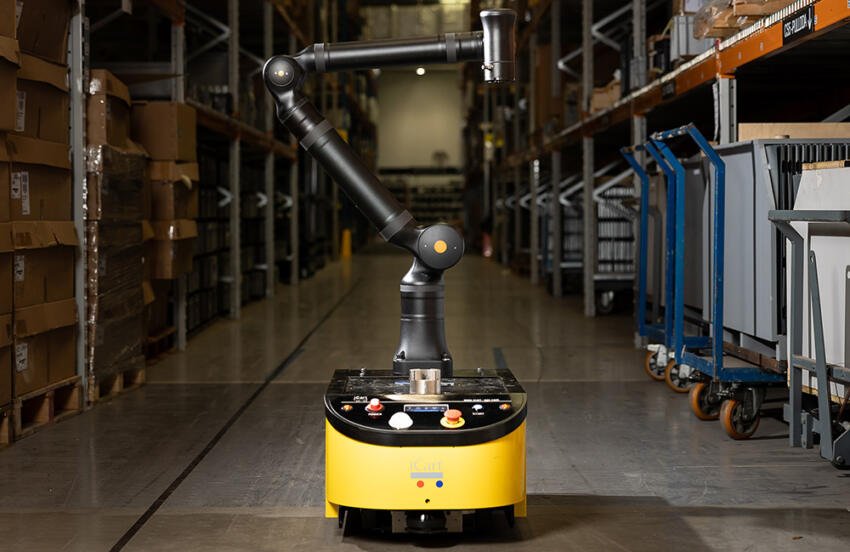
Kassow said its cobots can reach difficult-to-access areas, handle heavier objects, and perform demanding tasks with accuracy. | Robotics and automation have drastically changed operations as productivity needs and labor shortages impact the industry.
Workers are interacting with autonomous mobile robots and collaborative robots, or cobots, integrated into mobile manipulators. Cobots are quickly shaping the future of warehousing, with their use rising tenfold from 2018 to 2025. Some seven-axis models of force- and power-limited arms are gaining popularity because they can be mounted on AMRs, enabling a greater range of motion and access into harder-to-reach areas. Cobots offer numerous precision-enhancing capabilities across industrial environments, improving repetitive tasks such as picking, assembly, screwing, labeling, and welding, while helping to address ongoing labor challenges. Integrating these capabilities onto AMRs extends these benefits across the facility to streamline workflows and improve precision. This reduces the need for multiple cobot and industrial robot arm stations, reducing the number of manual and repetitive touchpoints for workers. Such integration includes loading or offloading materials and driving carts from station to station—tasks that a mobile manipulator can handle more easily. Cobots are designed for flexibility and precision Kassow’s robots have an integrated backdrive to facilitate positioning and programming. | These robots provide adequate force while reaching under and around obstacles more effectively, while working closer to the base of the robot, an area where six-axis arms are limited. This flexibility allows the system to complete more work with greater accuracy and in more orientations. Previously, making cobots mobile had one large unknown outlier—the controller. Static cobot arms require a large controller to be in a nearby cabinet. What makes next-generation cobots on AMRs special is that the controller can be built into the arm within a slim base on the robot, eliminating the need for the control cabinet. In addition, such cobots can run directly off of the AMRs’ batteries, allowing for a more compact solution, improving functionality and its footprint around a facility. Consider infrastructure and workers Staffers in production environments have long been taught to follow extensive safety protocols when working near or interacting with large industrial robots.