Beyond da Vinci: Why versatile humanoid robots are the next frontier in surgery
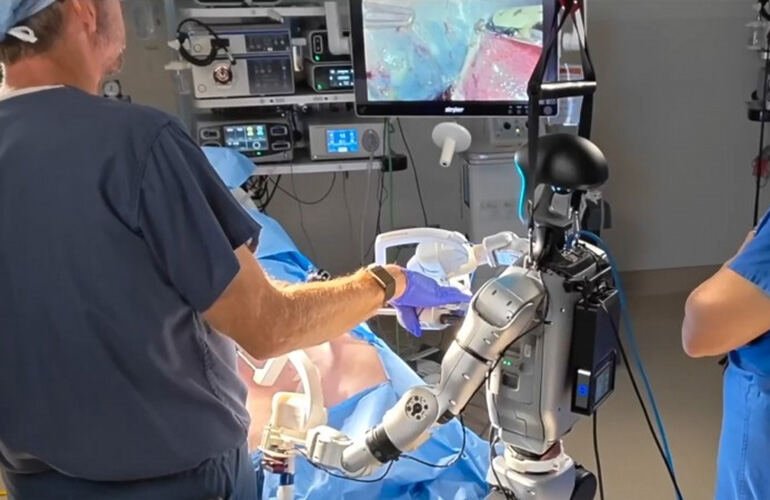
A team including a humanoid robot and a human surgeon successfully performed a gallbladder removal. | In one surgery, a team made up of a humanoid robot and a human surgeon acting as an assistant successfully performed a gallbladder removal.
A second successful procedure was performed by two humanoids working side by side in a robot-robot team. Both procedures were performed on large non-primate mammals. The proof-of-concept experiment is a first step toward introducing humanoids in the operating room, the researchers said. These robots could first assist during procedures, then later perform surgeries with teleoperation. “Remotely operated and autonomous humanoid robots have real potential for amplifying access to critical surgeries to which patients would otherwise not have access. This can help address the healthcare crisis not only in the United States, but also worldwide,” said Michael Yip, a faculty member in the UC San Diego Department of Electrical and Computer Engineering and one of the paper’s senior authors. Unlike dedicated platforms such as Intuitive Surgical‘s da Vinci Surgical System or Stryker‘s Mako Robotic Arm, the researchers focused on the thesis that humanoid robots are versatile and could perform a wide range of procedures and general tasks. The market leaders have proven that robotic systems have a place in the operating room; now the question is whether a humanoid robot can also support surgical procedures. “The procedure that we actually carried out was called colocystectomies,” explained Yip. “This is one of the most common procedures done for general surgery, where you’re removing the gallbladder. It’s common, but it’s also challenging to do because you need dexterous instruments.” “So things that have wrists at the end of their tools that you’re holding, and then you’re trying to do fine dissections and remove parts of the organ. And so it’s what everybody in general surgery gets trained on,” he told The Robot Report. “It’s a really good metric to evaluate how well somebody’s performing the surgery.” “So when you put a humanoid robot as an avatar for the doctor to control their actions and then perform the surgery, you can really measure if somebody was doing this procedure through the humanoid, what are the advantages? What are the challenges?” Yip said. Humanoid robots could improve access to surgical care The dedicated surgical robots are large, heavy, and typically installed in a single operating room.