China’s Orca world model matches specialized robotics systems without ever seeing a single action label
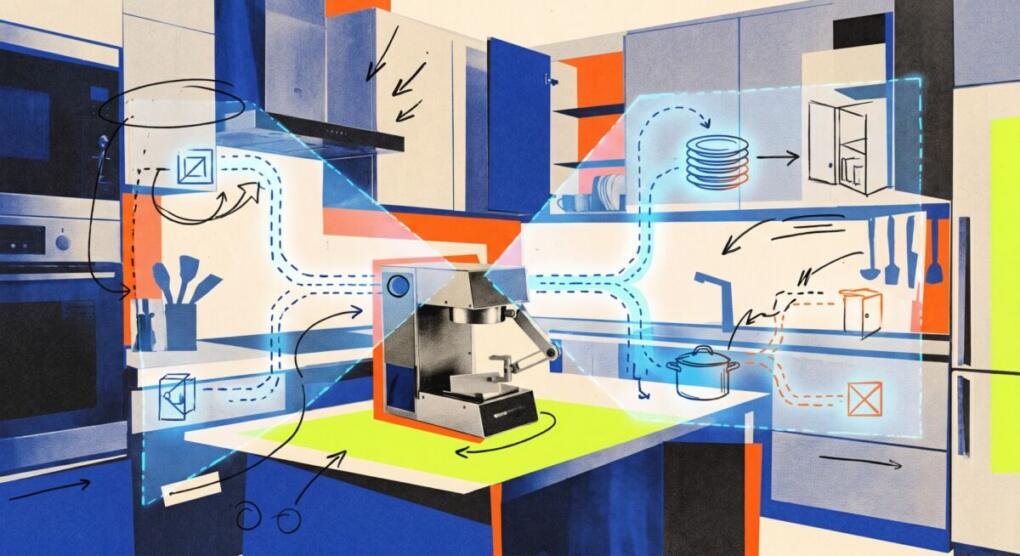
The Beijing Academy of Artificial Intelligence has released Orca, a world model that predicts abstract world states instead of tokens or pixels. Trained on 125,000 hours of video without a single action label, Orca matches the specialized π0.5 on five robotics tasks and could help ease the field’s chronic data shortage.
The Beijing Academy of Artificial Intelligence (BAAI) has released Orca, a “world foundation model” that breaks from the dominant approach in today’s AI. Instead of predicting the next token, the next video frame, or the next robot action, Orca models the next state of the world in an abstract internal representation. According to the technical report, intelligence shouldn’t be defined by specialized prediction models like language models, video generators, or robot controllers. What’s needed, the team argues, are models that build a general grasp of how the world changes and can use that as a base for many different tasks. Orca combines two learning modes. “Unconscious learning” uses raw videos without any captions. The model sees an image and predicts what the next one will look like, not at the pixel level, but in an abstract space, picking up motion patterns, occlusions, and typical scene dynamics along the way. “Conscious learning” adds verbal instructions. Videos are split into segments, each labeled with a description of the state change, so the model learns how a state shifts when a specific action happens. It also trains on classic video question-answering tasks so it can still respond to natural language queries. The pre-trained language-image model Qwen3.5 serves as the base, and after training, this core stays frozen. For each output type, the researchers attach a separate, smaller module that converts the internal state into the desired form. Text runs through Qwen3.5’s existing language head. For images, Stable Diffusion 3.5 stays unchanged too, with only small upstream adapters trained to pass Orca’s internal state to the image generator. Robot actions come from a control module trained from scratch called “Action Expert.” The split is intentional because the team says that it isn’t trying to chase top scores on single benchmarks.