AMD unveils Kria module for real-time control, unified memory for robots
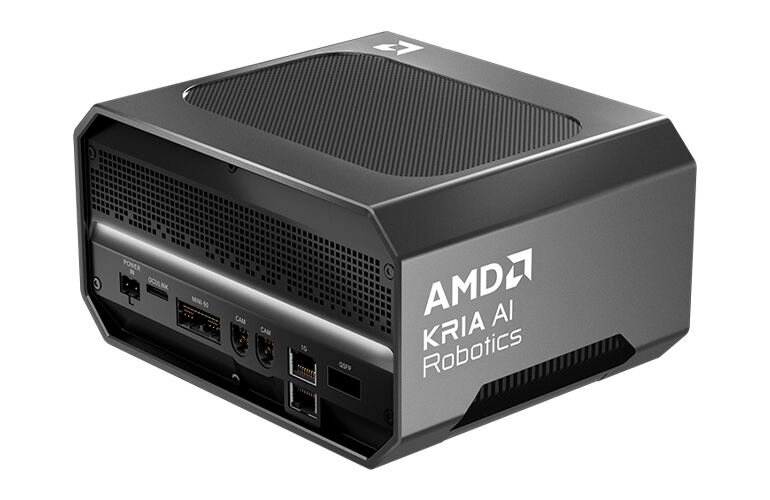
AMD Corp. — the Kria module is designed to deliver compute and AI workload processing for physical AI. | is making a full-stack play for robotics with its new Ryzen AI Embedded X100 series and Kria AI Robotics platform.
AMD today promised deterministic real-time control, unified CPU–GPU–NPU memory, and an open, non–vendor-locked software stack that it claimed can outperform NVIDIA Orin and Thor on system-level robotics workloads. Built on a unified memory architecture that reduces latency across CPU, GPU, and NPU, the Ryzen AI Embedded X100 line targets “firm” and “hard” real-time control via BIOS and Linux optimizations, AMD QoS (quality of service) features, and Zen-based virtualization. On top of the silicon, AMD is rolling out the Kria AI system-on-module and Robotics Development Kit, the open-source AMD Robotics Sophie Suite software stack, and a curated Robotics Partner Network. The Santa Clara, Calif.-based company said they position it to support everything from industrial arms and autonomous mobile robots (AMRs) to humanoids with a single, scalable platform. AMD launches Ryzen AI embedded X100 processor AMD earlier this month announced the new Ryzen AI Embedded X100 family of system-on-a-chip (SoC) components. The new chips deliver a unified CPU–GPU–NPU architecture with a focus on embedded AI use cases, said the company. It designed the X100 for high-end robotic and edge AI applications based on its earlier sibling, the P100. AMD delivered a “shot across the bow” of NVIDIA‘s chipset designed for physical AI applications. The X100 is now AMD’s flagship SoC for robotics applications. The new Ryzen X100 is the flagship SoC for the AMD robotics lineup. | This is key for tasks such as perception, sensor fusion, and planning tasks, and unifies it all on a single platform. Developers can deploy the X100 into a variety of firm or hard real-time applications. “Firm real time” is achieved via Linux + BIOS optimizations (interrupt latency target < 7 μs at six-nines). In addition, by using AMD QoS, the system can deliver L3 cache reservation, memory bandwidth allocation, and thread isolation. For hard real-time use cases via virtualization, AMD recommended the Zen hypervisor, FreeRTOS virtual machine, cache coloring, and VM isolation.