NVIDIA Cosmos-H-Dreams: Bringing Real-Time Generative Simulation to Surgical Robotics
Hugging Face 1. From Surgical World Model to Interactive Simulator 2.
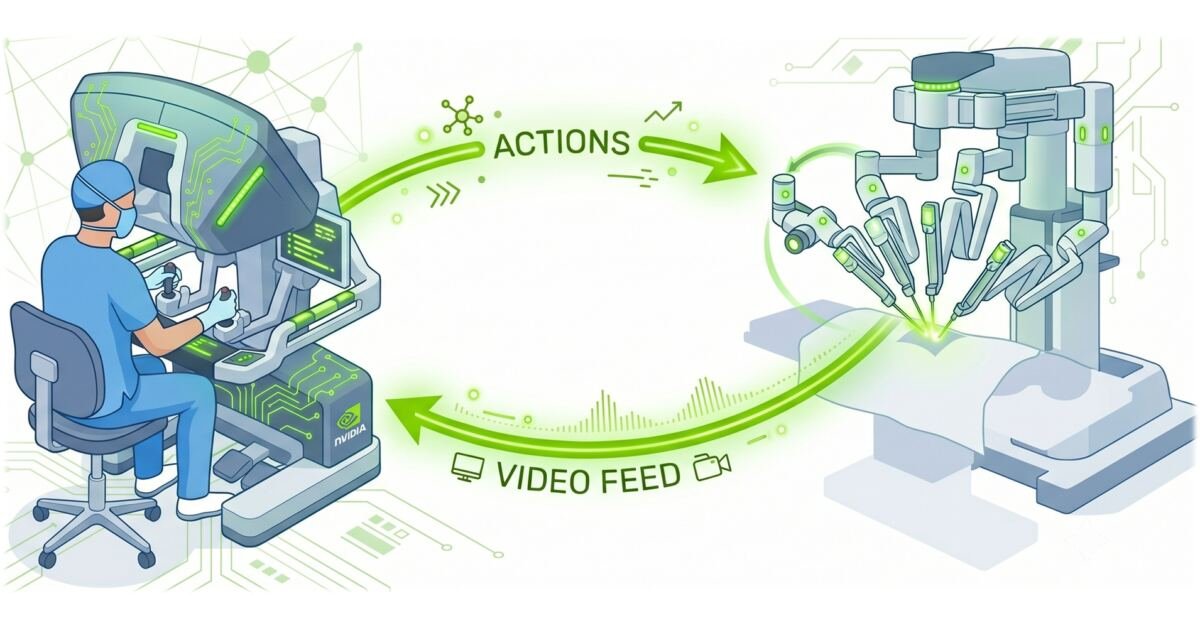
Distilling Cosmos-H-Surgical-Simulator for Real Time 2.1. Self-Forcing Distillation 3. FlashDreams: The Real-Time Inference Engine 4. Adapting to Your Own Data 5. What Is Next: Toward Closed-Loop Surgical Physical AI 6. Get Started Today Surgical robotics is moving quickly from teleoperation toward increasingly capable vision-language-action policies. But evaluating and training these systems remains difficult. Physical robotic platforms are expensive to operate, experiments are slow to reproduce, and failures can damage instruments or biological material. Conventional simulators provide a safer alternative, but surgical scenes are exceptionally difficult to model: deformable tissue, fine instrument interactions, specular surfaces, sutures, needles, smoke, and occlusions all matter. World foundation models offer a different path. Instead of manually authoring every object and physical interaction, they learn visual dynamics directly from synchronized video and robot kinematics. NVIDIA’s Cosmos-H-Surgical-Simulator demonstrated this approach by generating future surgical video from an initial scene and a sequence of robot actions. It enabled faster-than-physical evaluation and synthetic data generation across the Open-H-Embodiment ecosystem. Today, we are introducing the next step: Cosmos-H-Dreams, a real-time, action-conditioned generative simulator for surgical robotics. Cosmos-H-Dreams distills the capabilities of Cosmos-H-Surgical-Simulator into a causal, few-step student model and serves it through FlashDreams, NVIDIA’s accelerated streaming-inference library. Running on a single NVIDIA RTX PRO 6000 GPU, the result is an interactive environment that a person or a learned policy can control in a closed loop. From Surgical World Model to Interactive Simulator Cosmos-H-Surgical-Simulator is an action-conditioned world foundation model built on NVIDIA Cosmos-Predict2.5-2B and post-trained on the Open-H-Embodiment dataset. Given a surgical context frame and a future robot trajectory, it generates video showing the likely visual consequences of those actions. This makes it useful for offline policy evaluation and synthetic data generation. A recorded or policy-generated trajectory can be sent to the model, the corresponding rollout can be generated, and the result can be inspected or scored without repeatedly executing the motion on a physical robot.