Record, train, and deploy from one place with Strands Agents, LeRobot, and Hugging Face Storage Buckets
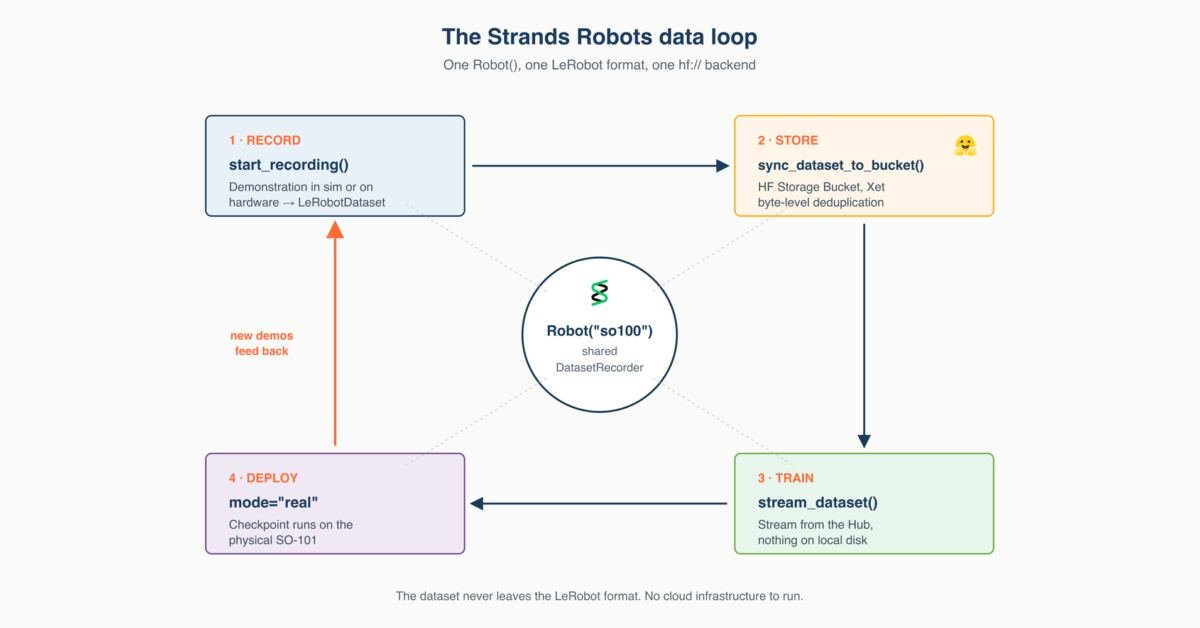
What you'll build Prerequisites Step 1 – Record a demonstration into a bucket Step 2 – Store with byte-level deduplication Step 3 – Train by streaming from the Hub Step 4 – Deploy the policy and return data to the loop Try it using the sample application Security Considerations Clean up Where to go from here Resources A walkthrough of the streaming data loop in Strands Robots, one agent loop that records robot demonstrations, trains on them by reading straight from the Hub, and deploys the policy back to hardware, with the dataset in the same on-disk LeRobot format the whole way through. You have an agent that can already record a demonstration and push it to the Hugging Face Hub.
Now you want to run that loop continuously: collect episodes through the day, train a policy on the growing dataset, deploy it, and pull the next batch back to improve it. Run that loop once and every piece works. Run it every day and you start paying for the same byte transfers over and over. The recordings you upload keep growing, each training run copies the whole dataset to the GPUs before it starts, and every new checkpoint ships out while the next batch of recordings comes back. The first post in this series introduced Strands Robots, an open source SDK from AWS (Apache 2.0) that exposes robot abstractions, simulation, and the LeRobot stack as AgentTools you compose into a single Strands agent. It covered the Robot() factory, recording a demonstration in simulation, running a policy, and deploying the same agent code to a physical SO-101. That factory resolves a name against a registry of arms, humanoids, mobile bases, and hands, so the SO-100 used throughout this post is one of many supported embodiments. The robot catalog lists every robot the factory knows about. LeRobot’s dataset format is already used by over 90,000 datasets and models on the Hub from more than 8,000 publishers (LeRobot Project Pulse). A Strands Robots recording is one more of them, so anything built to read LeRobot data can read it without conversion. If you are new to Strands Robots, start there; this post assumes that setup. That post followed the agent loop in one direction, from a Hub dataset to a physical robot. This one follows the data the other way, from the first recorded frame back to the deployed policy, over Hugging Face Storage Buckets – a mutable, non-versioned, Xet-backed object-storage repository type announced in March 2026. A bucket sits beside your dataset repositories in the same hf:// namespace and uses the hf CLI you already have, so it becomes the working layer that holds your data between the day you record it and the day you train on it. Someone has to decide which episodes to keep, when the scene has drifted far enough to re-record, whether today’s batch is enough to train on, and which checkpoint replaces the one on the arm.