AGIBOT Hosts World Challenge 2026, Testing AI Models on Real-World Tasks
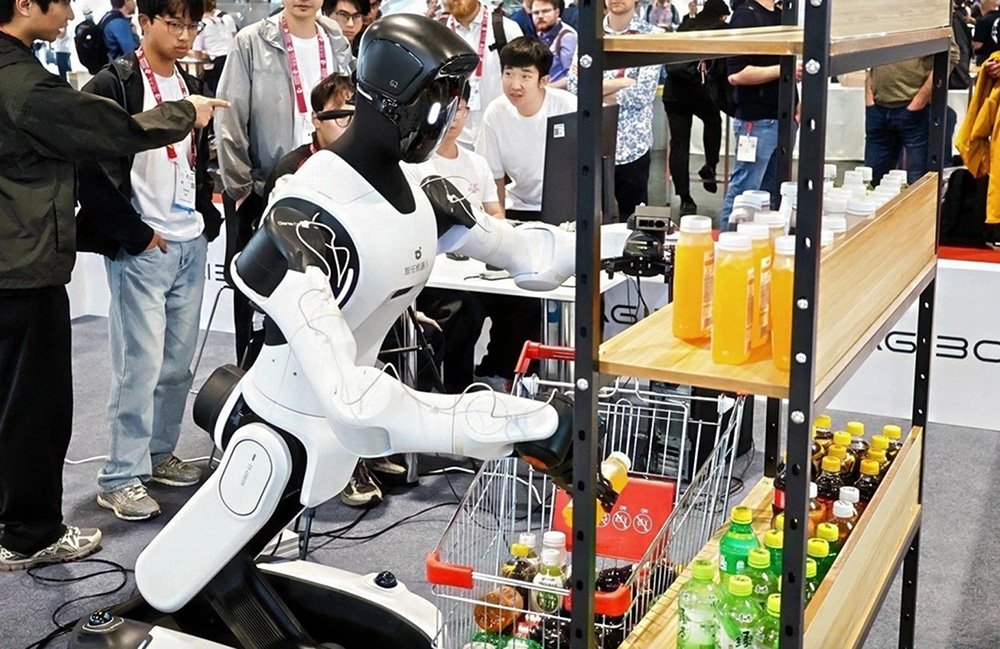
The Robot Report — participants in the challenge tested and debugged robots working on different tasks. |
last week hosted the AGIBOT World Challenge 2026 alongside ICRA 2026 in Vienna. The company brought together 526 research and enterprise teams from 27 countries to compete across two embodied AI tracks: “Reasoning to Action” and “World Model.” Shanghai-based AGIBOT said the competition highlighted a key shift in how embodied AI is evaluated. The company said it showed that the industry is moving beyond simulation scores toward closed-loop testing on real robots, real tasks, and standardized benchmarks. The competition adopted a benchmark-driven format that combined online automated evaluation with an offline real-robot final in Vienna. With AGIBOT’s EWMBench and Genie Sim Benchmark, the consistent framework enabled automated testing, standardized metrics, and reproducible results. During the offline final, finalist teams completed tasks using the AGIBOT G2 humanoid robot. By incorporating real-robot validation into the evaluation process, the competition placed robot stability, real-world adaptability, and long-horizon task reliability at the center of the scoring system. The company, also known as Zhiyuan Robotics Co., said this more closely aligns technical evaluation with practical deployment needs. The challenge drew research and industry teams from leading institutions and companies, including the Chinese Academy of Sciences, Tsinghua University, the University of Science and Technology of China, the University of California San Diego, Russia’s Sber Robotics Center, Alibaba, Amap, and vivo. More than 100 teams surpassed the official baseline. What’s the difference between the R2A and WM tracks? The two tracks at the AGIBOT World Challenge 2026 reflected the broader evolution of embodied AI from task execution toward understanding, prediction, and decision-making, according to AGIBOT. The Reasoning to Action (R2A) track evaluated how robots understand tasks, plan actions, and execute them in physical environments. The R2A track, upgraded from the 2025 Manipulation track, expanded the evaluation from action execution to the full process of environment understanding, task planning, and physical execution. The World Model (WM) track focused on how AI systems predict physical-world changes and model interactions based on robot actions and sensor inputs.