Autonomique deploys semi-humanoid robots and AI at Canadian Tier 1
The Robot Report — autonomique’s AI platform and mobile manipulator are moving from the lab into factories.
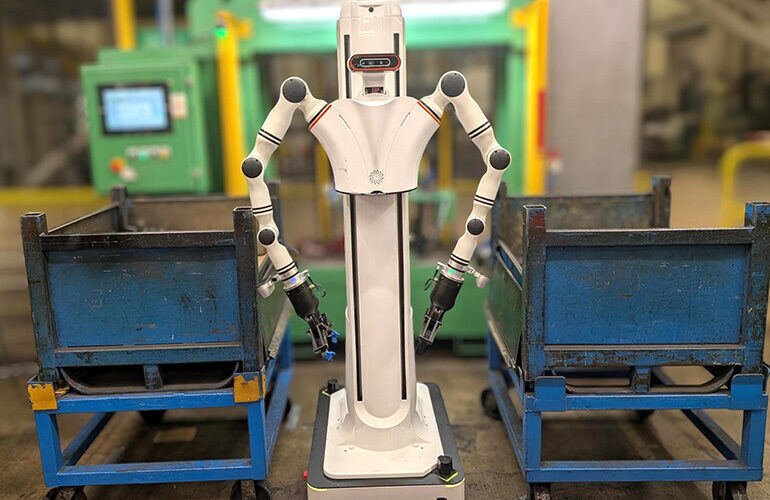
However, traditional automation, built for fixed and repetitive tasks, often struggles to adapt, according to Autonomique Inc. The company today said that its physical AI platform, which is designed to address this challenge, is progressing toward production deployment at Tier 1 automotive supplier F&P Manufacturing Inc. “There is enormous excitement in robotics today, but most of it remains demo-grade: systems that look impressive yet routinely fail under real production demands,” stated Vikrant Tomar, co-founder and CEO of Autonomique. “Manufacturing demands precision, repeatability, and zero tolerance for fragility. We built Autonomique to close that gap; our intelligence layer brings genuine adaptability to industrial robotics without sacrificing the reliability manufacturers depend on.” Tomar has a Ph.D. in AI and was previously founder and chief technology officer of Fluent.ai. Spun out of SRI International in 2024, Autonomique said it has developed hardware-agnostic software to add human-like dexterity and reasoning to industrial robots. “Some of the technologies that we license out of SRI include its teleop system that was already being used by U.S. Army for bomb disposal, as well as by some pharma companies in their cleanrooms,” Tomar told The Robot Report. “The idea is to be able to integrate into any type of robotic embodiment, get control data, and train AI models with that. The second component is a more generalized foundational spatial understanding and reasoning engine, allowing a robot to understand the world and think about it.” Autonomique uses teleoperation based on SRI research. The Menlo Park, Calif.-based company said its autonomy platform has a “generalist-specialist” architecture enabling industrial robots to perceive, reason, and execute multi-step workflows while adapting quickly to new tasks without major retraining. “Instead of having one large vision-language-action [VLA] model, we’re building this framework where the generalist AI can choose a deterministic skill for a task,” Tomar explained. “For insertion, for example, it’s better to use online reinforcement learning, but for when failures or other types of things happen, maybe I should use these more flexible, newer VLA models.