Daimon Robotics building the infrastructure layer for tactile intelligence
When handling flexible objects, inserting components, or manipulating delicate items, robots need information about forces, slippage, and contact that visual systems may miss. Daimon Robotics wants to provide the infrastructure to help robots develop that capability. Rather than focusing exclusively on tactile sensors or developing a single foundation model, the company is building a pipeline that connects tactile sensing, data collection, simulation, and AI models. Its goal is to turn physical interactions into useful training data that helps robots perform manipulation tasks more reliably. “By building tactile intelligence, we’re actually playing the role as an infrastructure provider,” Daimon’s Partner & VP of Technology Dr.
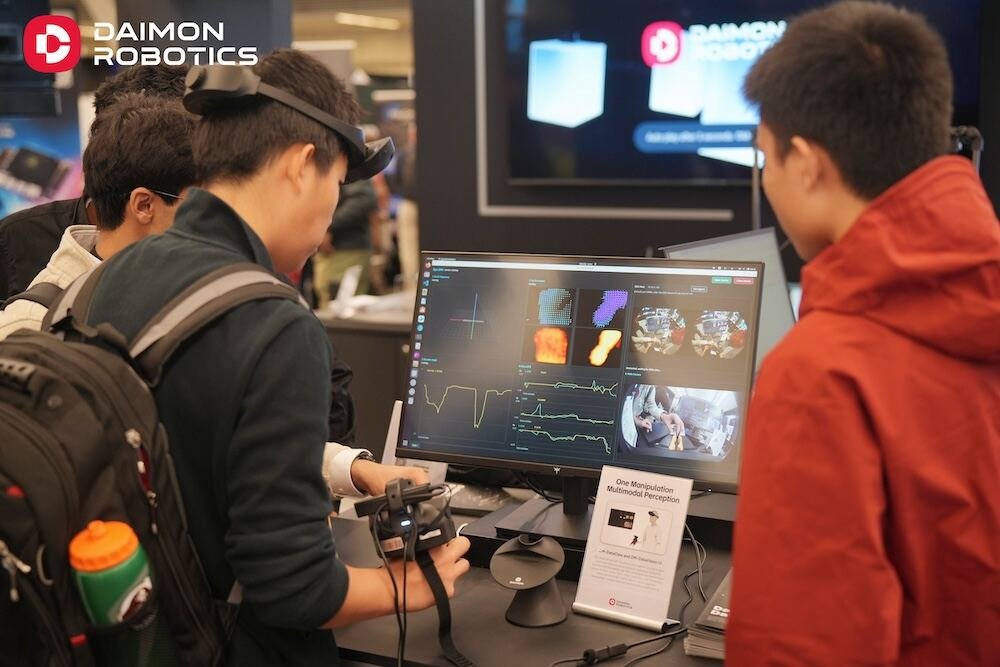
Zhu told The Robot Report. “We’re not aiming to be a foundation model developer. We are providing the infrastructure for doing so for those downstream customers.” That distinction is central to Daimon’s strategy: develop the tools and data infrastructure that other companies can use to build more capable robotic systems. Building a pipeline for tactile data Collecting useful tactile data at scale presents a challenge. Unlike visual data, which can be captured relatively easily with cameras, tactile data depends on physical contact. The resulting information varies with an object’s material, geometry, the forces applied, and the task being performed. Daimon is developing a pipeline to capture and process these interactions, with tactile feedback operating at 30 Hz. The company is also working to connect real-world data with simulation, allowing physical interactions to inform training in virtual environments. The sim-to-real gap remains a significant challenge, particularly when accurately reproducing physical properties such as friction and contact forces. Daimon’s approach starts by calibrating simulations against real-world measurements before transferring collected data into simulated environments. “Let’s be frank; it’s not good enough. It’s kind of terrible,” Zhu said of the current state of simulation, referring to the gap between simulated and real-world environments. Daimon is developing tactile simulations that account for physical properties measured through real-world testing. The goal is to improve the fidelity of those simulations and make it easier to transfer learned capabilities to physical robots. The company has discussed collecting more than 10,000 hours of data, with its longer-term Daimon-Infinity initiative targeting more than 1 million hours of tactile embodied data. Zhu also emphasized the importance of working with companies developing robotic models and applications. “Doing everything ourselves was not enough,” he said. “Collaborating internationally in different downstream scenarios is really important.” That collaboration helps Daimon understand what other developers need from its sensors, data-collection devices, software, and evaluation tools. A robot might need to determine whether a component is properly seated, detect when an object slips, or adjust its movements when a part behaves unexpectedly. Tactile feedback can help it respond to these conditions. The company demonstrated applications involving delicate manipulation at IROS 2026, including applying heat-transfer designs to tote bags and threading bracelets. It also showed a robot collecting and packaging broken glass, illustrating how models trained on data from varied scenarios can be prompted to perform specific tasks. Daimon uses its Umi device to collect data from human interactions.