Ground Robots Inherit the Kill Zone
IEEE Spectrum Robotics — borys Drozhak has a vision: a frontline almost free of humans, patrolled by flying drones and ground robots, and continuously monitored by AI-controlled sensor networks. And it’s not a pipe dream.
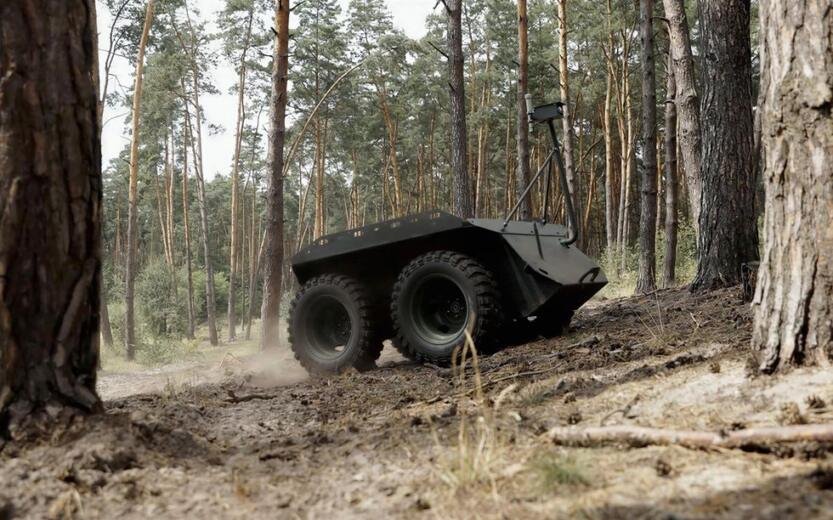
Ukrainian roboticists have made major strides in that direction over the past four years. Remotely controlled ground vehicles fitted with machine guns and grenade launchers now patrol the no-man’s land straddling the front, part of a robotic legion that has stymied Russia’s territorial ambitions so far this year.Drozhak is a co-founder and CEO of RoverTech, which manufactures the Zmyi, one of Ukraine’s most successful ground robots. Zmyi, Ukrainian for snake, is an 800-kilogram (1,700-pound) rover, 2.15 by 1.5 meters in size, with 75-centimeter diameter wheels. The Zmyi comes in various configurations—for demining, logistics, fighting fires, firing a machine gun, or launching grenades. According to Drozhak, the UGV is a record-breaker among Ukrainian ground robots. It’s engineered to be nearly noiseless and emit as little heat as possible, helping it to elude Russia’s intelligence, surveillance, and reconnaissance (ISR) drones. As a result, a Zmyi rover completes on average 57 missions across the kill zone before being destroyed. The kill zone is the roughly 35-kilometer-wide swath of land that straddles the front line; its width is variable and determined mainly by the growing range of the drones.“Usually, a UGV [uncrewed ground vehicle] on the battlefield lasts about seven missions,” Drozhak says. “The Zmyi is quite a bit bigger and stronger” in comparison with most other UGVs, “and can make it back even if two of its wheels get destroyed.”Drozhak is a software engineer turned roboticist whose story is echoed everywhere in the Ukrainian defense establishment. Before the Russian invasion, he was living a quiet life in Ireland, working for an international software development firm. He returned home shortly after the war began to help defend his homeland. Together with his friend, Vasyl Korenovskyi, who had been a mining engineer, he founded RoverTech with the goal of building robots to perform some of the most dangerous tasks in the war zone. In 2023, they rolled out their first product–the Zmyi de-miner. Earlier this year, one of RoverTech’s assault UGVs was part of a widely reported operation that forced a group of Russian soldiers to surrender without the presence of any Ukrainian troops. Such feats, Drozhak insists, are not rare on Ukrainian battlefields these days.UGVs are the latest chapter in the mil-tech race spurred by the war in Ukraine.