How we make AI coding more cost efficient without sacrificing task quality
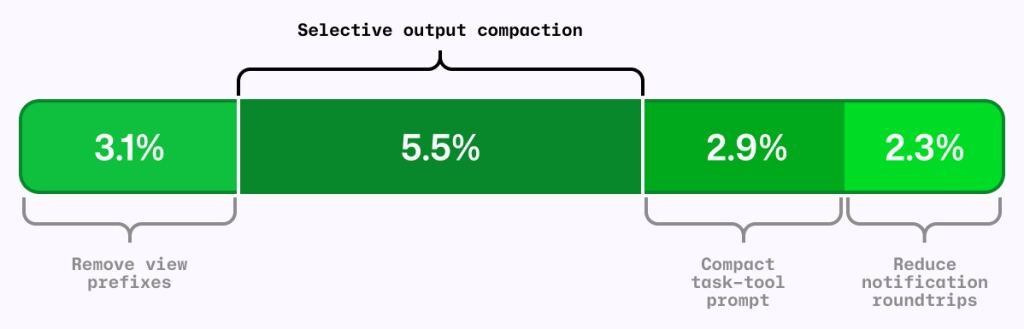
figure — output quality is important when working with AI coding agents, but true efficiency comes from getting work done quickly, efficiently, and with the right context. That’s why token count of individual interactions alone isn’t a meaningful measure of efficiency.
The goal shouldn’t be to use fewer tokens, but to tap into the right amount of context to move a task forward. A concise tool response can sometimes require additional calls or work if it leaves out information the agent needs, ultimately making the task slower and more expensive. That’s why we want to optimize for the outcome rather than the tool call. This post examines four changes in GitHub Copilot that put that principle into practice: Preserve useful context while reducing repetitive output. Remove formatting that adds no value to the task. Shorten instructions without changing useful behavior. Deliver completed background work without an extra retrieval step. Possible changes were evaluated offline using agentic coding benchmarks. The most promising changes were then validated through controlled online experiments before shipping. The examples in this post come from GitHub Copilot CLI. Multiple other Copilot products, such as the GitHub Copilot app and Copilot code review, use the same underlying harness and also become more efficient through these improvements. Figure 1: Four independent A/B experiments using the same AI-credit metric. The segments are shown together for comparison; their effects are not necessarily strictly additive. The local metric trap It’s common to shorten the output from each tool call as a way to reduce agent costs. RTK (Rust Token Killer) is a utility that shortens shell output before an agent reads it. We evaluated its effect on GitHub Copilot using our agentic coding benchmarks.