Intel Crescent Island 160GB to 480GB LPDDR5X AI GPU at Hot Chips 2026
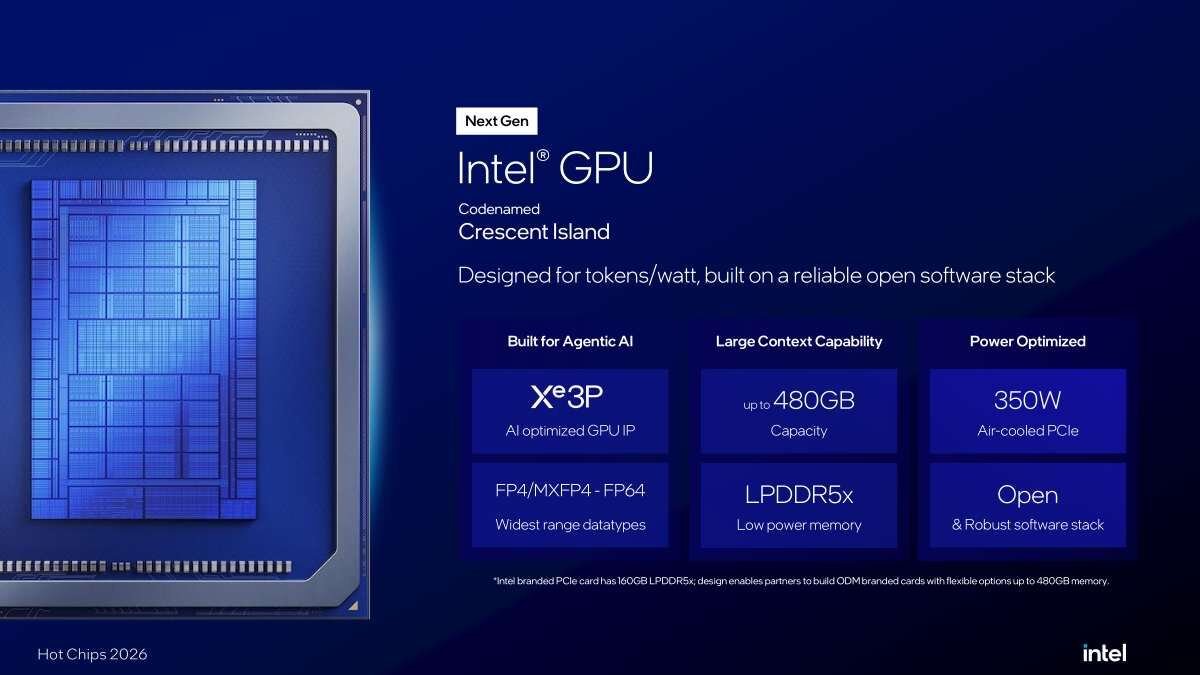
Intel opened Hot Chips 2026 by laying out Crescent Island, a data center GPU purpose-built for agentic AI inference. Chief Enterprise AI Systems architect Sumit Mohan and Intel Fellow Hong Jiang walked through a design centered on tokens per watt, large memory capacity, and an open software stack.
We covered Intel’s AI roadmap at its Computex 2026 keynote earlier this summer, and this talk fills in the accelerator that sits at the top of that portfolio. This session is being written live, so please excuse any typos. Agentic AI shifts the pressure points compared with plain chatbots. Intel frames the problem in terms of latency, memory capacity, and system throughput, since tool calls, long context, and CPU-GPU coordination all tax the platform at once. Placing Crescent Island in Intel’s broader accelerator portfolio makes clear it is the enterprise data center play. Across local agent computers, AI workstations, and data center intelligence centers, Intel spreads everything from Arc Pro GPUs and SambaNova SN50 RDUs up to this new inference GPU. Here is Intel’s roadmap timeline, which runs from 2020 into 2026 and beyond, showing that Crescent Island is not a first-generation architecture but rather part of a lineage dating back 6+ years. Crescent Island is a 350W, air-cooled PCIe GPU built around tokens per watt. Intel says the branded card ships with 160GB of LPDDR5x memory, while the design allows partners to build ODM cards with flexible options up to 480GB, covering data types from FP4 and MXFP4 up to FP64. Intel describes this as the third generation of its Xe Matrix Extensions. These XMX engines add a 3-way extended Xe matrix with FP4 precision co-issue and FP64 support, built on a 16-deep systolic array and optimized from the engine up to the core for efficiency. This top-level die shows 32 Xe cores feeding 256 XMX engines. All the surrounding memory and fabric work exists to keep those units busy. Crescent Island is Xe3p, and the generation table shows how far the design has come from Battlemage. Where Xe2 delivered 20 Xe cores and a 4-deep systolic XMX, Crescent Island brings 32 Xe cores, a 16-deep systolic array, a 1MB GRF and 512KB L1 per Xe core, a 32MB unified L2, and up to 480GB of LPDDR5x.