Modernizing the global economy with industrial robotics is needed but not inevitable
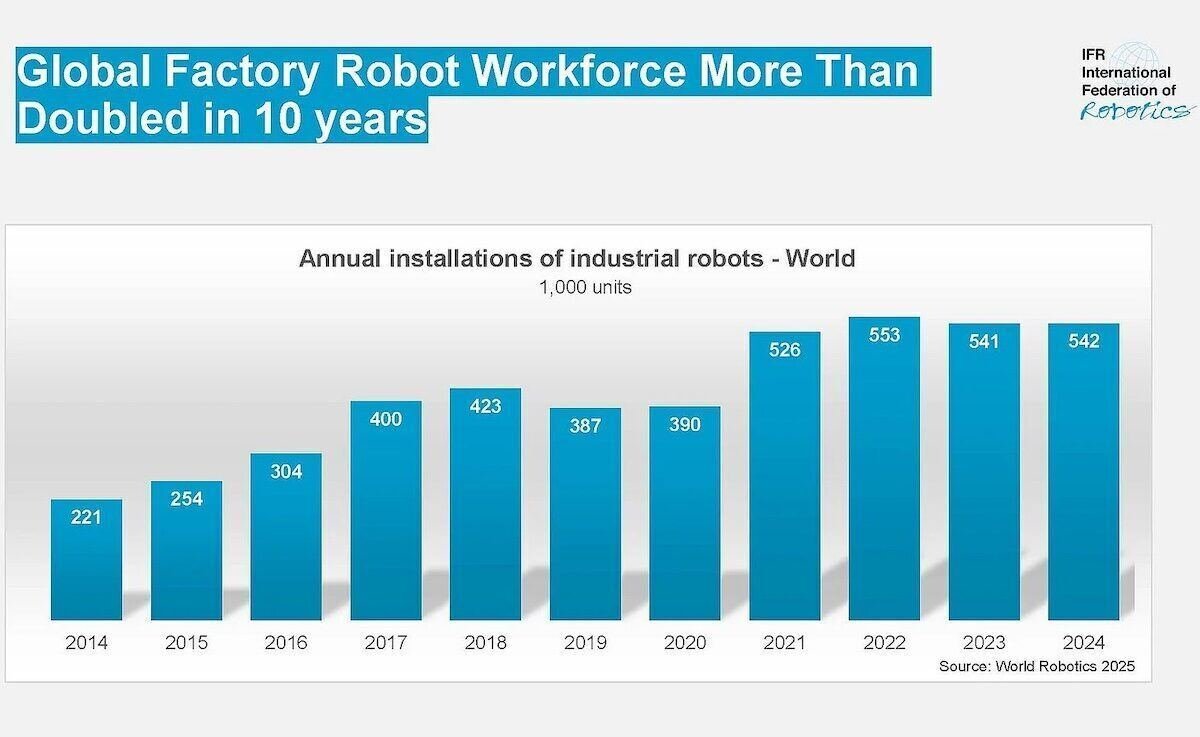
The Robot Report — industrial robot adoption has continued to increase, according to the IFR. The modern robotics market is divided into several industrial clusters: service and consumer.
Both market segments have seen a steady increase in industrial robotics sales, according to the International Federation of Robotics, or IFR. In 2024, 229,000 robotic systems for industrial use were sold, with 70% of global sales coming from just five countries: Japan, China, the U.S., Germany, and the Republic of Korea, according to the IFR. These countries have a number of government programs aimed at supporting and developing robotics industry strategies, although the U.S. relies more on private capital than federal funding. Let’s discuss the key economic priorities for the implementation of robotic technologies and how this can transform the economy. More than 343 companies worldwide manufacture industrial robots, and over 347 companies integrate robotic systems into production processes. Also, more than 860 companies produce service robots for professional use, and 204 companies produce service robots for personal use. A classification of robot types to follow There are four distinct thematic clusters: Basic robotics technologies Medical robotics Key robotics technologies Promising areas of innovative development These last ones include energy harvesting from the external environment, self-repairing robots, multimodal interfaces, gesture analysis and synthesis, and swarm intelligence in flexible production modules. Service robots are divided by application into professional and personal. Sales of service robots for professional use accounted for 11.5% of the total, reaching 24,207 robotic units last year. Military and special-purpose robots accounted for 45% of this total (11,000 units). Last year, 4.7 million service robots for personal use were sold. This eloquently demonstrates a total revenue increase of 28%. Sales volumes increased to $2.2 billion. The IFR predicted significant growth for all market segments of the robotics market.