Nvidia details Rubin architectural optimizations for inference – improvements target better performance and efficiency from the GPU to the rack
Nvidia’s upcoming Vera Rubin platform, set to arrive later this year, will take the stage as the AI world shifts towards an era dominated not by frontier training runs but by the demands of agentic AI inference at massive scale. The hunger for generated tokens in agentic workflows and the demands of delivering them quickly, efficiently, and at low unit cost now dominate the discussion.
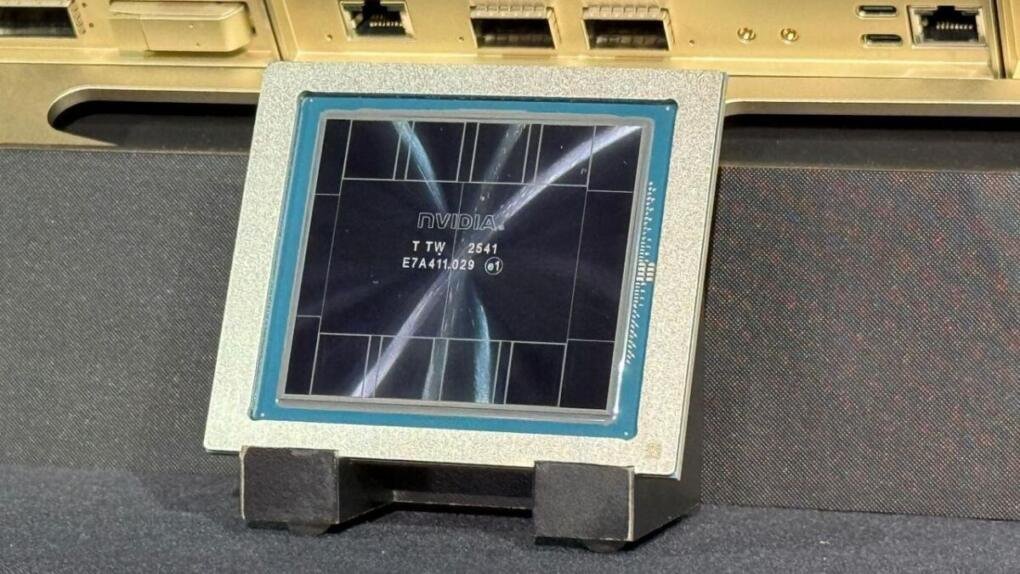
We’ve already gone in depth on new performance data around the Vera CPU and how it helps to accelerate agentic AI workloads, but that’s not all Nvidia is sharing today. It’s also detailing some new features of the Rubin architecture and how those features are meant to increase inference efficiency from the GPU level to rack-scale and data-center-scale implementations of this accelerator platform. (Image Rubin joins two compute dies onto a single package using the Nvidia High Bandwidth Interface. The resulting chip offers 224 Streaming Multiprocessors (SMs) containing a total of 896 Tensor Cores alongside 288GB of HBM4 memory providing 22 TB/s of memory bandwidth. As an inference-focused accelerator, Nvidia touts Rubin’s 50 sparse PFLOPS of NVFP4 inference throughput as its headline performance figure, although that’s only one of a dizzying array of data types this chip can handle. Here are some key rates to keep in mind for this chip so far: Nvidia Rubin GPUNVFP4 Inference50 PFLOPS (with sparsity)NVFP4 Training35 PFLOPSFP8/FP6 Training17.5 PFLOPSINT8250 TOPSFP16/BF164 PFLOPSTF322 PFLOPSFP32130 TFLOPSFP6433 TFLOPSLet’s dive into some of Rubin’s refinements for inference workloads to understand how Nvidia aims to keep all of those resources fully utilized.The Rubin Tensor Memory Accelerator efficiently manages growing MoE modelsFirst up, Nvidia highlights efficiency improvements in the Tensor Memory Accelerator (TMA) that help feed the Tensor Cores with data. The TMA is a dedicated engine built to handle memory address calculations and perform direct loads of array data into a GPU’s shared local memory.Leading AI model architectures have moved from dense models where every parameter is activated per output token to a mixture-of-experts (MoE) architecture where only certain specialized sub-networks are activated per token, based on the guidance of a router that helps judge which experts are best suited to processing a given input. MoE expert weights can be distributed across GPUs in order to efficiently utilize limited per-GPU HBM capacity. Nvidia says that Rubin’s TMA has been improved to deal with the challenges of managing the growing numbers of experts in today’s leading models. (Image The Rubin TMA now supports GPU kernels that maintain and update a single unified MoE descriptor directly in the TMA instruction at runtime, reducing computation of MoE descriptor metadata and requiring less calculation overhead for data movement. This approach frees up GPU cycles for inference calculations, which is, of course, the place that you want your expensive AI accelerator spending the vast majority of its time.Doubled K-dimension throughput, double the Tensor Core outputRubin also improves the fundamental performance of matrix operations in the Tensor Core by doubling the amount of work those cores can perform on the K dimension, or the shared inner dimension of a pair of matrices to be multiplied. Without going too deep into the math, the size of the K dimension is directly related to the number of times the Tensor Core has to loop over the elements of the two matrices being multiplied. (Image Nvidia says this improvement has wide-ranging benefits for throughput-, memory-, and latency-bound kernels, and it’s helpful for both context processing and decode phases of inference.Softmax on Rubin gets up to a 4X boost versus BlackwellRubin also focuses on improving the performance of the attention mechanism that’s foundational to transformer-based LLMs More advanced models now support context lengths of up to a million tokens, and quickly performing attention calculations on such long input sequences quickly is a key driver for improved inference performance. Softmax is an essential operation in attention calculations, and in order to keep up with the improved Tensor Core throughput in Rubin, Nvidia has once again boosted softmax throughput in the GPU SM’s Special Function Unit (SFU). Since it relies on the transcendental math capabilities of the SFU, softmax throughput can become a bottleneck for subsequent inference work, and it’s a limitation that Nvidia already sought to address with enhancements to the Blackwell Ultra SFU.