5 Physical AI Infrastructure Platforms Shaping Robotics in 2026
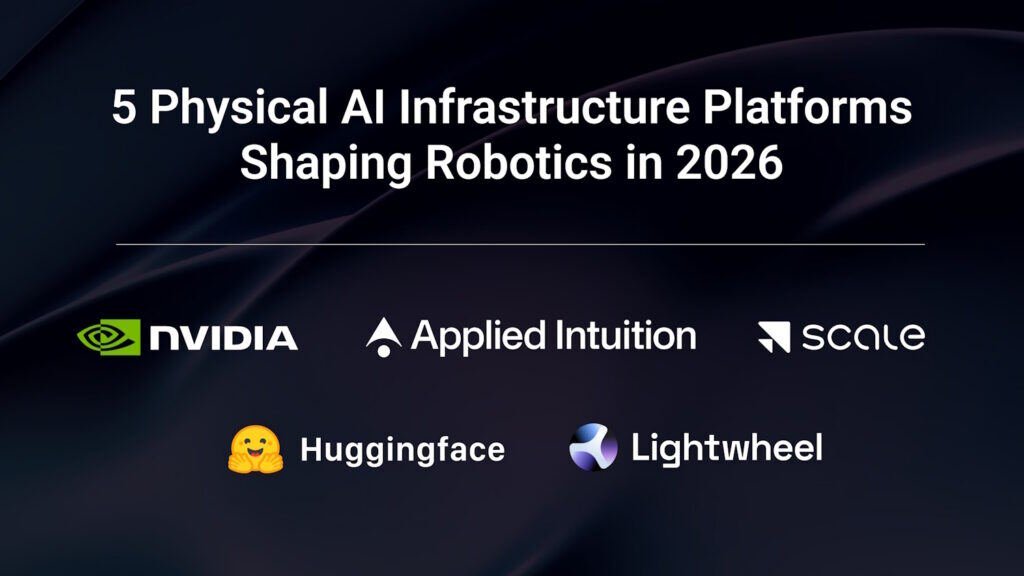
NVIDIA Corp. — from accelerated computing and simulation to data operations, open-source tooling, validation engineering, and continuous learning, these five platforms represent distinct control points in the emerging physical AI stack. For most of the modern AI boom, infrastructure had a single center of gravity: compute.
Models grew larger, training runs consumed more GPUs, and the industry organized itself around accelerators, cloud clusters, training frameworks, and developer software. That stack was sufficient when AI’s outputs were text, images, video, or code. Physical AI changes the definition. A robot does not simply run a model. It must perceive a changing environment, reason about contact and motion, act through a specific body, and recover when its actions fail. Its development cycle spans real-world demonstrations, synthetic data, physics simulation, policy training, structured evaluation, deployment, and the collection of new failure cases. Physical AI infrastructure is becoming a system of interdependent layers rather than a synonym for computing capacity. This list focuses on horizontal infrastructure: platforms reusable across robot makers, embodiments, and industries, excluding robot manufacturers and model developers. To qualify, a platform had to address a critical bottleneck, provide reusable infrastructure rather than a point solution, support multiple robotics developers, and show public evidence of deployment, ecosystem adoption, or open-source contribution. The five are not ordered by valuation or revenue; each represents a different control point in the emerging physical AI stack. NVIDIA: The accelerated computing and simulation substrate NVIDIA remains the most foundational company in the physical AI infrastructure stack. Its importance begins with accelerated computing, but the company has been steadily extending upward into robot development, simulation, synthetic data, foundation models, and policy evaluation. NVIDIA Isaac now spans simulation and robot-learning frameworks, CUDA-accelerated libraries, AI models, and reference workflows: Isaac Sim for physically based simulation, Isaac Lab for robot learning and foundation-model training, Isaac GR00T for general-purpose humanoid development, and Isaac Lab-Arena for large-scale, GPU-accelerated policy evaluation. Newton extends the stack at the physics layer: developed with Google DeepMind and Disney Research and managed by the Linux Foundation, it is an open-source, GPU-accelerated physics engine built for robot learning, covering contact, friction, rigid and soft-body dynamics, actuators, and sensors. The strategic advantage is not any single product but NVIDIA’s ability to connect computation, world generation, physics, synthetic data, model training, evaluation, and edge deployment inside one developer ecosystem, the closest thing physical AI has to a common development substrate.