Protein Design with RFD4-Proteina and Hugging Face Spaces
Hugging Face define the design task, generate proteins, and build a repeatable design workflow. Protein design starts with setting a goal: a target to bind, a molecule to recognize, or an arrangement of atoms to preserve.
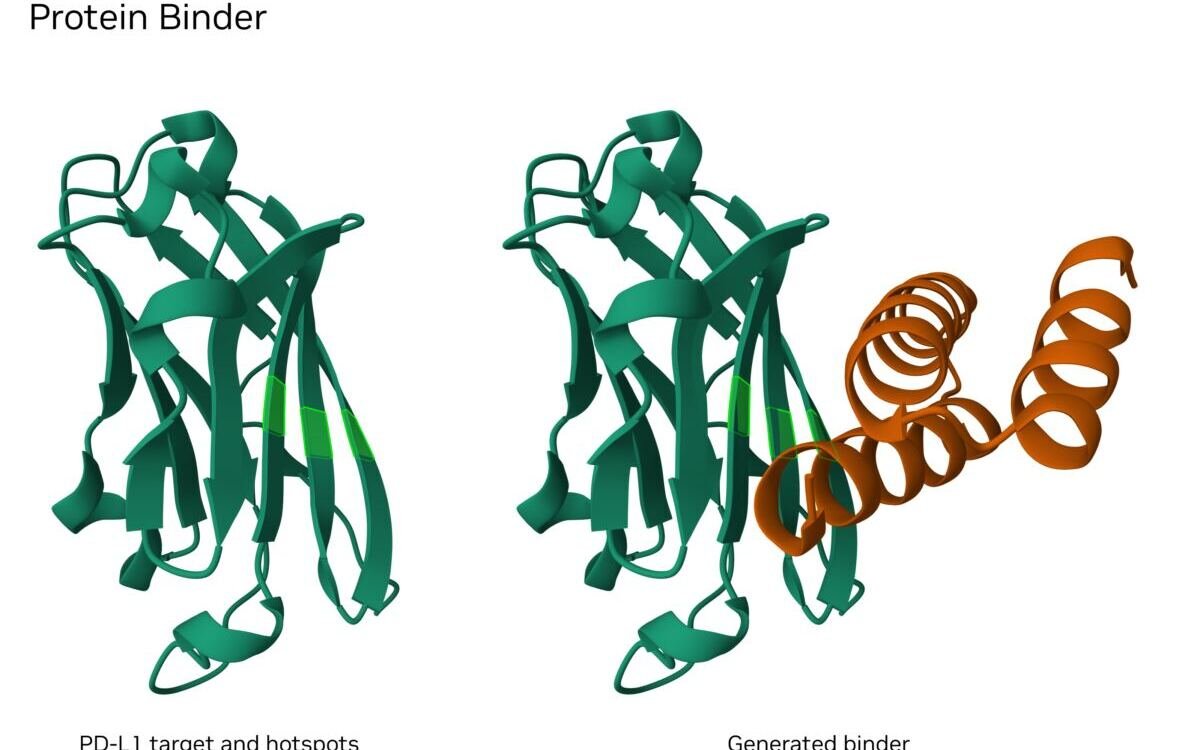
Turning that goal into a design has usually meant splitting up the workflow across models that each handle one modality or one stage and reassembling the pieces afterward. Information is lost at every handoff. RFD4-Proteina is a BioNeMo open model for programmable protein design, co-developed by NVIDIA and the University of Washington’s Institute for Protein Design. It brings protein sequence and all-atom structure generation into one model, reducing the handoffs between separate backbone, sequence, and all-atom structure design models. It can generate proteins in molecular contexts that include other proteins, small molecules, nucleic acids, glycans, metal ions, and modified amino acids (e.g., a phosphorylated residue on a target protein). RFD4-Proteina pairs a flow-matching model with an autoencoder. The autoencoder represents each standard or modified amino acid, sugar, DNA, or RNA nucleotide as an anchor-atom coordinate (for amino acids, the alpha carbon) and a learned latent vector encoding its chemical identity and local geometry. The flow model generates anchor coordinates and latent vectors together, and the decoder expands them into all-atom 3D structures and sequences. This lets the model generate sequences and structures together around a supplied constraint: the target a binder must engage, or the catalytic motif a protein must contain. You can run the model in your browser before installing anything, in either of two Hugging Face Spaces: the dedicated RFD4-Proteina Space, which runs on dedicated GPUs, and the ZeroGPU Space, which runs on shared capacity. Start with a supplied example, inspect a target and its generated designs, and save the input and output for further work. From October 21 to November 4, 2026, NVIDIA is sponsoring free access to the dedicated RFD4-Proteina Space, which runs on NVIDIA RTX PRO 6000 GPUs. Try it on your own design problems, including the protein design competition sponsored by Anthropic and Adaptyv. Try RFD4-Proteina • Explore the RFD4-Proteina model The built-in PD-L1 example shows the target and its design annotations before generation. The expandable binder segment is part of the input specification.