Training a coding model to paint watercolours with TRL and OpenEnv
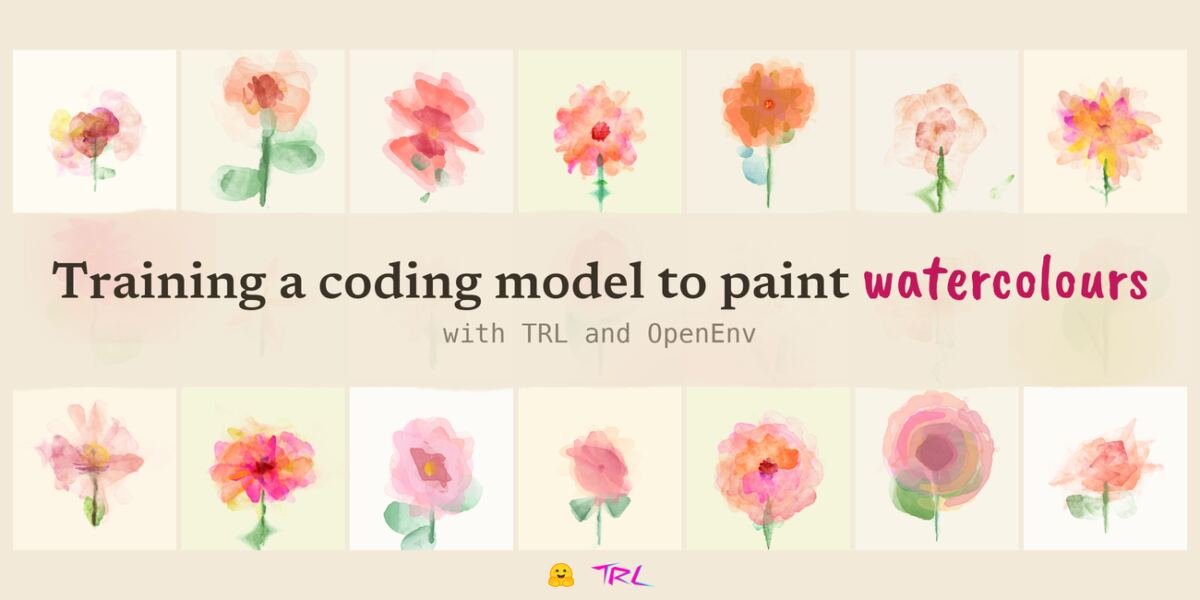
Hugging Face why people loved it RL over taste The RL environment you need to build The pool is the reward function Just one more yolo run What it actually learned Infra is hard What it costs What I would try next What I changed from the original Everything is published On 23 August, Surya Narreddi posted a beautiful video of watercolours painted by a language model. The model writes JavaScript through p5.brush, a library that “adds natural drawing tools to p5.js”.
The video went viral fast, over 1.5M views at the time of writing. The video came with a blog post explaining the training behind an earlier and narrower stage of the project, close-up flowers rather than the full compositions in the video, sadly without open artifacts yet. His site says a full technical report is coming, so ensure you follow him. The original idea is his, coming from the art and design side, where his skills are way beyond mine. My attempt is on the engineering side, reproducing the recipe in the open with every piece published. Note: for the context behind the project, told by Surya himself, watch this video of his thesis. In this article I try and reproduce his idea with TRL and OpenEnv. The reference pool dataset, the RL environment, the training scripts and the trained models, all open. The whole pipeline runs on Hugging Face, end to end: Once the two Spaces are up, the recipe is one command. Duplicate the environment and the scorer model, set two environment variables for the reward mix, and launch: hf jobs uv run train/watercolour_grpo.py –flavor h200 –timeout 48h –secrets HF_TOKEN — –env-url https://<you>-watercolour-env.hf.space –model Qwen/Qwen3.5-35B-A3B –lora –all-linear –bf16 –gradient-checkpointing –subject ‘a peach hibiscus’ –references 4 –top-p 0.95 –top-k 20 –lr 5e-5 –lr-scheduler constant_with_warmup –warmup-steps 5 –scale-rewards none –steps 110 –n-episodes 240 –num-generations 8 –per-device-batch-size 1 –gradient-accumulation-steps 8 –max-completion-length 8192 –run-tag my-run –out <you>/watercolour-grpo –push-to-hub The rest of this article is the story of getting there, and every piece is in the repo. I have followed the original blog step by step, and only changed something when strictly needed. Every idea of my own went into a list instead of into the experiment, and that list became “What I would try next” at the end, next to the full list of published artifacts. If you have already read his post, the framing and the reward design will be familiar. The new material is the open implementation, the hand-rated pool, and three reward mixes trained and compared, and it starts at The RL environment you need to build. The paintings look loose, imperfect, handmade, at a moment when image models produce perfect (statistically average) pictures.