U.S. robotics industry saw double-digit growth in 2025, says IFR
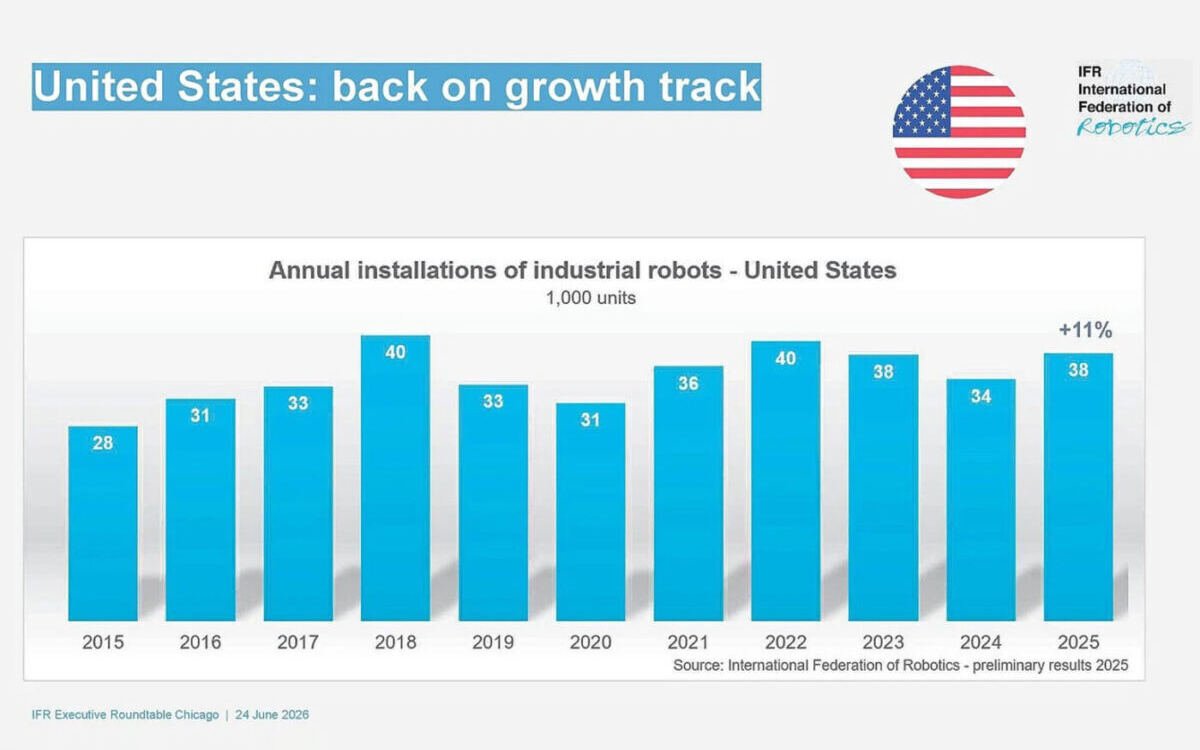
The Robot Report — a chart showing annual installations of industrial robots in the U.S. |
U.S. robotics installations reached 38,000 units in 2025. Robust growth in the food industry and other non-manufacturing sectors drove this recovery, said the Frankfurt, Germany-based organization. However, the automotive industry still remains the largest adopter, reaching 13,500 units, just 1% below last year’s result. “The United States is back on the growth track,” said Takayuki Ito, the president of the IFR. “While automotive achieved its third-best result in seven years, the data highlights a growing demand for flexible automation in the food industry: Adoption in this sector surged by 30%, now ranking alongside metal and machinery and electrical-electronics, all with approximately 3,000 installations in 2025.” The degree of automation in the U.S., as measured by robot density, stands at 307 industrial robots in use for every 10,000 employees in the manufacturing industry. This places the U.S. in eighth position worldwide, two ranks up from the previous year. The U.S. is behind top automated countries such as South Korea (1,220 robots), Germany (449 robots), and Japan (446 robots), but ahead of China (166 robots). U.S. vs. China: The importance of a national robotics strategy However, China far outperforms the rest of the world in terms of market size: Annual installations in China reached 295,000 units in 2024. This represents a global market share of 54%. The IFR has not published preliminary results for China 2025 yet, but according to its estimates, installations are about 10 times higher than the number in the U.S.