Universal Robots launches its seventh generation robot platform at IMTS
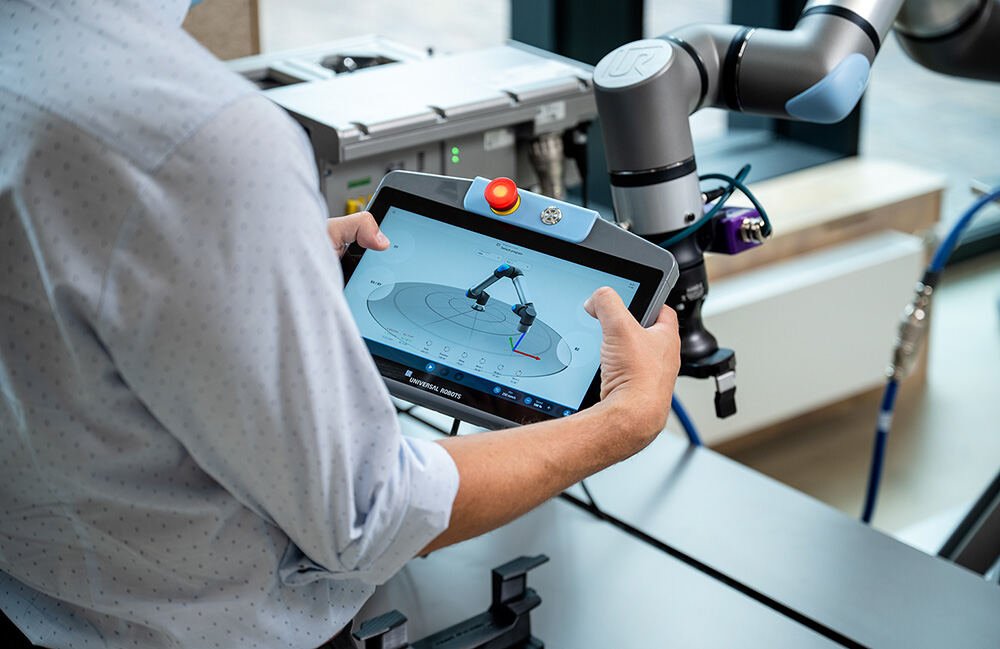
The Gen 7 platform is designed to enhances the cobot user experience, says UR. | The Teradyne Inc. subsidiary said the unified system upgrade enables customers and partners to deploy advanced AI-powered applications into industrial operations with the same robot experience that operators, technicians, engineers, and integrators prefer to work with every day Anchored by the PolyScope X robot operating system, Gen 7 has a fully re-engineered control box, teach pendant, and tool flange.
UR said it designed all of these to make demanding tasks and setups easier. The Odense, Denmark-based company also added three new robot arms, UR10g-1750, UR17g-1300, and UR18g-950, named after their payload (in kilograms) and reach (in millimeters), to its e-Series and UR Series lineup. They are larger than some of its previous models. “Our vision as a whole at the Teradyne Robotics Group is really to be this destination platform for physical AI,” Will Healy, the director of product and industry marketing, told The Robot Report. “You can do research in a lab, but ultimately you have to deploy it. Our robots are absolutely uniquely suited to deploy for these companies that are trying to actually do AI in a factory.” As a whole, Teradyne has been putting more emphasis on AI in recent years. In its most recent earnings statement, the company marked its fifth consecutive quarter of growth. Teradyne credited AI as a main driver of its revenue growth. “The reason people buy from UR over and over again, in surveys and interviews, is because of our ease of easy, our ease of deploy, our ease of programming,” Healy said. “The goal here is to make it even better, especially in this world of AI.” Universal Robots downsizes controller without sacrificing power With the Gen 7 release, Healy said UR redesigned its controller from the bottom up. | The controller enables multi-network communication for modern automation and physical AI architectures, connecting to PLCs, HMIs, MES platforms, IPCs, and vision systems, reducing the need for external switches. “We wanted to make [the controller] much more robust, so it can run bigger programs and more complex programs, industrial-size programs,” said Healy. “It’s much more compact than the previous one.” CB7 is available at launch in a standalone control box version and a compact version for integration into an automation cabinet. The system is also compatible with e-Series and UR Series force- and power-limited robot arms. “There’s two versions at launch, and really ultimately the idea here is trying to just enable the integrator. The biggest thing about the control box is what we’re bringing to network architectures,” Healy said.