Up to 3.2x Faster Inference with LFM2.5-DSpark
Hugging Face how does DSpark work Training and Architecture Quality parity Inference Speed Up on CPU and GPU How to use LFM2.5-DSpark Get Started Citation Today, we release DSpark draft model checkpoints for three models from our LFM2.5 family: LFM2.5-1.2B-Instruct, LFM2.5-2.6B, and LFM2.5-8B-A1B. These add a speculative decoding path that trades a minimal memory increase for a large decoding speedup without changing output quality: The decode phase in LLM inference is traditionally memory-bound.
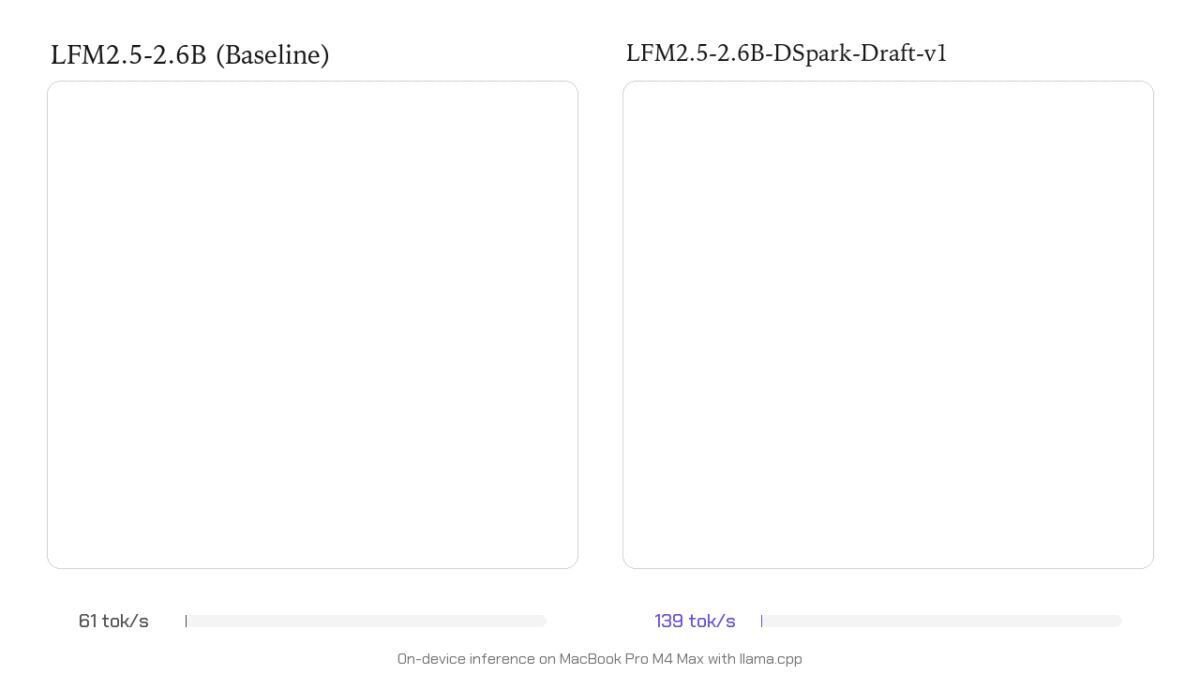
Most latency comes from streaming weights from DRAM into SRAM, not from intense computation. Speculative decoding addresses this by using a lightweight draft model to produce candidate tokens, then having the target model verify them all in a single forward pass, sharing the cost of loading the weights across all tokens we verify. Over the years, multiple approaches of speculation have been proposed, with the most prominent being EAGLE-3, DFlash, and, most recently, DSpark, which combines three components: We follow the DSpark recipe with a larger and more diverse data mix covering SFT, chat, code, and function-calling data. Based on our ablations, the first versions of the draft models are simplified attention-only draft models, with 5 layers and a block of 9. For each draft model, we ran 15 epochs on the entire dataset and selected the epoch with the highest acceptance rate rather than the lowest loss. The resulting draft models are relatively small, with each around ~300M parameters. Under greedy decoding, a draft token is only accepted if it matches the target model’s distribution. On rejection, the target model’s own token takes its place. The emitted sequence is therefore identical to baseline greedy by construction, so benchmark accuracy (pass@1 or exact match) is unchanged. Our DSpark draft models for LFM2.5 ship with day-one support for llama.cpp (implementation builds on top of the official codebase, which we run with experimental metal kernels) and **SGLang (**implementation builds on the official SGLang implementation of DSpark). We measure on-device throughput with llama.cpp and Metal on an M4 Max MacBook Pro using FP16 GGUF weights and up to 256 output tokens. We measure GPU throughput with SGLang on a single H100 80 GB in BF16. Both configurations use a DSpark block size of 9, a batch size of 1, and a temperature of 0. We evaluate them on five benchmark datasets. All three drafter models deliver noticeable throughput improvements on both the large-scale accelerator (H100) and the edge deployment (M4 Max MacBook).