With the new VENTUNO Q board, Arduino hopes to make robotics development easier
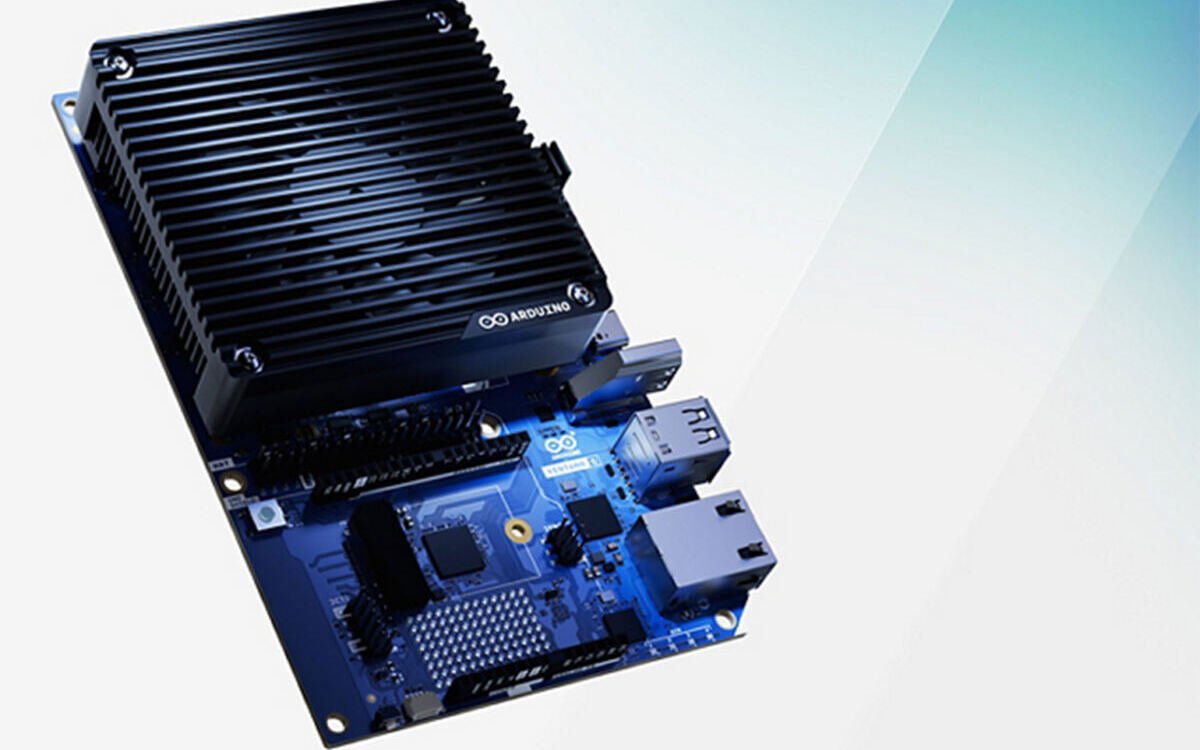
Arduino VENTUNO Q’s dual-brain architecture pairs a Qualcomm Dragonwing IQ8 Sprocessor with a real-time STM32H5 microcontroller. | r.l., a subsidiary of Qualcomm Technologies Inc., recently opened pre-orders for VENTUNO Q, a edge AI platform powered by the Qualcomm Dragonwing IQ8 Series.
Arduino built the board for developers, prioritizing familiarity and ease of use with the right software, accessories, and extensions. While this is Arduino’s first intentional step into robotics, Marcello Majonchi, chief product officer of Arduino at Qualcomm, said the company has more than 20 years of experience working with robotics developers. “This is the first intentional step for a product that is meant to be used as a single point of control of a modern robotics platform,” he told The Robot Report. “At the same time, Arduino is extensively used in the robotics domain, and there are thousands of different types of robots that, over the past 20 years, have been developed by the community and powered either in some features or in entirety with an Arduino product.” Qualcomm integrates Arduino technology Last year, Arduino was acquired by Qualcomm, which quickly gave the Monza, Italy-based company access to more resources and a new base of customers. This, along with recent advances in generative AI and processor sizes, made the new board feel like a natural evolution, said Majonchi. “We have this amazing computing power. We have this ecosystem that is just waiting for something with an easier way for people to be able to translate their vision into reality,” he noted. “What is the gap that we need to bridge from a hardware perspective and from a software tooling and frameworks perspective so that you don’t need five different Ph.D.s to figure out how to build up an AMR?” Technical details of the VENTUNO Q VENTUNO Q has a dual-brain architecture. It pairs a Dragonwing IQ-8275 processor, delivering up to 40 dense TOPS of AI performance, with 16 GB LPDDR5 memory, 64 GB eMMC, and expandable M.2 NVMe storage alongside a dedicated STM32H5 real-time microcontroller. Arduino said this enables systems that don’t just interpret sensor data, but also respond to it physically, immediately, and offline. The board ships with pre-loaded Ubuntu, distributed by Canonical. The Arduino App Lab offers a fast path to a working prototype. Developers can also choose VS Code, native Linux tools, or any existing workflow. On the MCU side, the Arduino Core on Zephyr RTOS is designed to provide deterministic, real-time control of motors, CAN-FD, PWM, and high-speed GPIO. When building the board, Arduino said it wanted to ensure that much of the things customers expect from any of its other boards carries over into the VENTUNO Q.