What do you do with a humanoid robot when it breaks down?
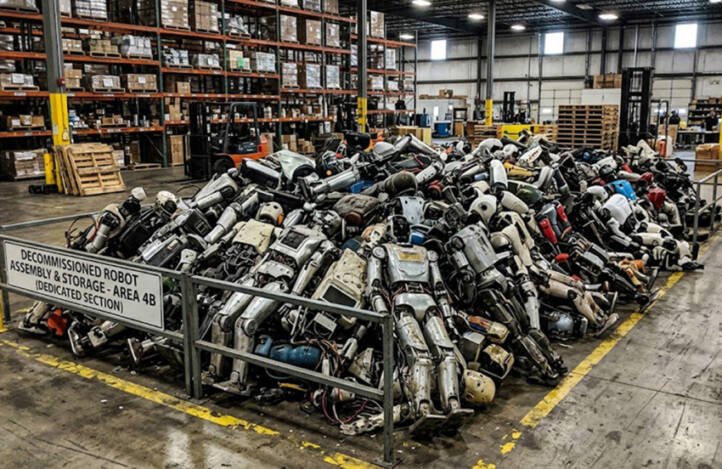
Apple — like other complex machines such as cars and computers, humanoids will need to be recycled. Industry leaders regularly debate how to source, assemble, and deploy these machines, which contain anywhere from 10,000 to 15,000 individual components.
But an inevitable, multi-billion-dollar question remains unaddressed: What happens when they retire? Decommissioning humanoids is not a matter of traditional scrapping. It’s a highly technical, high-stakes surgical endeavor. The anatomy of the challenge To understand the complexity of recycling a humanoid robot, first you have to look at the sheer density of its subassemblies. A standard unit is made up of 200 to 500 major sub-components, broadly categorized into four interconnected systems with hard shell or pliable coverings: Actuation and motion: 20 to 40 electric motors, each paired with precision speed reducers and gearboxes. Modern manufacturing increasingly favors integrated, sealed drive modules that combine the motor, harmonic drive, and localized controls into a single unit. The kinematic skeleton: A complex structural frame made of 30 to 50 major elements — often aluminum alloys, lightweight carbon fiber, or titanium — bound together by 1,000 to 3,000 specialized fasteners, bolts, and pins. The artificial nervous system: An intricate sensory network requiring 40 to 80 position encoders, 50 to 200 distinct sensors, tactile pressure points, and advanced perception arrays. They include lidar, IMUs, and cameras threaded together by miles of internal cabling. The semiconductor core: Up to 80 memory and storage semiconductor devices regulating firmware and localized processing. Because of this architectural density, end-of-life processing presents massive liabilities across four critical areas: 1. The kinetic data breach A retired robot is a goldmine for corporate espionage. Memory assets contain proprietary navigation maps, biometric logs, facial recognition recordings, and behavioral patterns. If storage media is not physically destroyed or cryptographically erased, repurposing the hardware leaves “backdoors” to extremely sensitive enterprise or consumer data. 2.