Accelerating vision-language models with LFM2.5-VL-DSpark
Hugging Face how does speculative decoding work for VLMs Training and Architecture Inference Speedup on CPU and GPU Limitations of speculation for vision workloads How to use LFM2.5-VL-DSpark Get Started Citation Today, we release an experimental DSpark draft model for our vision-language model (VLM) LFM2.5-VL-3B. As with our recently released LFM2.5-DSpark drafter models, it adds a speculative decoding path that trades a minimal increase in memory footprint for a larger speedup without changing output quality.
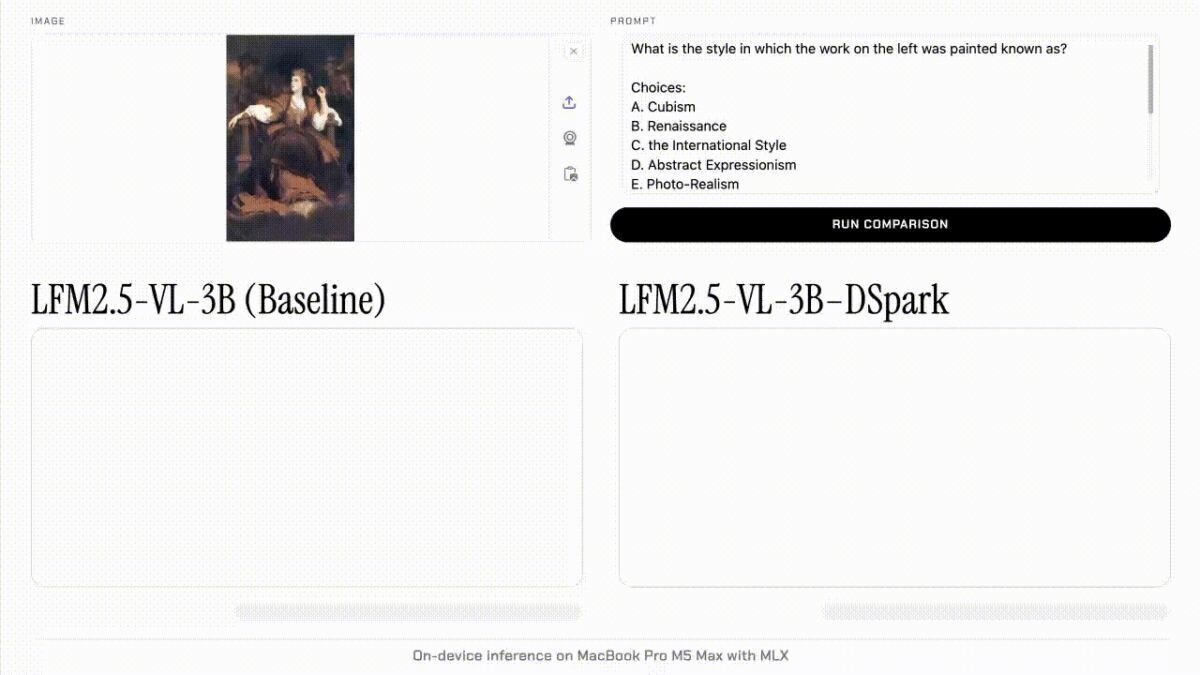
The vision drafter uses the same architecture as our text LFM2.5-DSpark drafters: it captures the target model’s hidden states at a fixed set of tapped layers and conditions on them to draft a block of k candidate tokens. Image patches and text tokens are projected into a shared representation before those layers, so the drafter operates on hidden-state vectors of identical dimensionality regardless of input modality. The inference algorithm is therefore unchanged from the text models. We follow the DSpark recipe with a mixture of vision-language SFT data, weighted toward the workloads we expect the model to serve. Based on ablations across 3, 4, and 5 layers, the draft model is a simplified attention-only drafter with 4 layers and a block size of 9. We ran 10 epochs on the final mixture and measured acceptance after each, which improved with additional training tokens before reaching diminishing returns. At inference time, we recommend a block size of 8 or 9 depending on the hardware. The resulting drafter has approximately 280M parameters and increases the deployed model’s parameter count by just 8.9%. The DSpark draft model for LFM2.5-VL-3B ships with day-one support for llama.cpp, MLX-VLM, and SGLang. We measure both on-device inference and GPU inference. Both configurations use a DSpark block size of 8 and are evaluated on six diverse vision-based tasks, including general VQA, text VQA, image captioning, chart VQA, complex reasoning, and multi-turn conversation, following the MMSpec benchmark. On-device inference. With MLX on an M5 Max, decoding runs 2.30x to 3.13x faster by task. End-to-end latency improves by 1.56x to 2.62x. With llama.cpp on an M3 Ultra, decoding improves by 1.57x to 2.14x and end-to-end by 1.30x to 1.77x.