The Robot I Didn’t Expect to Build
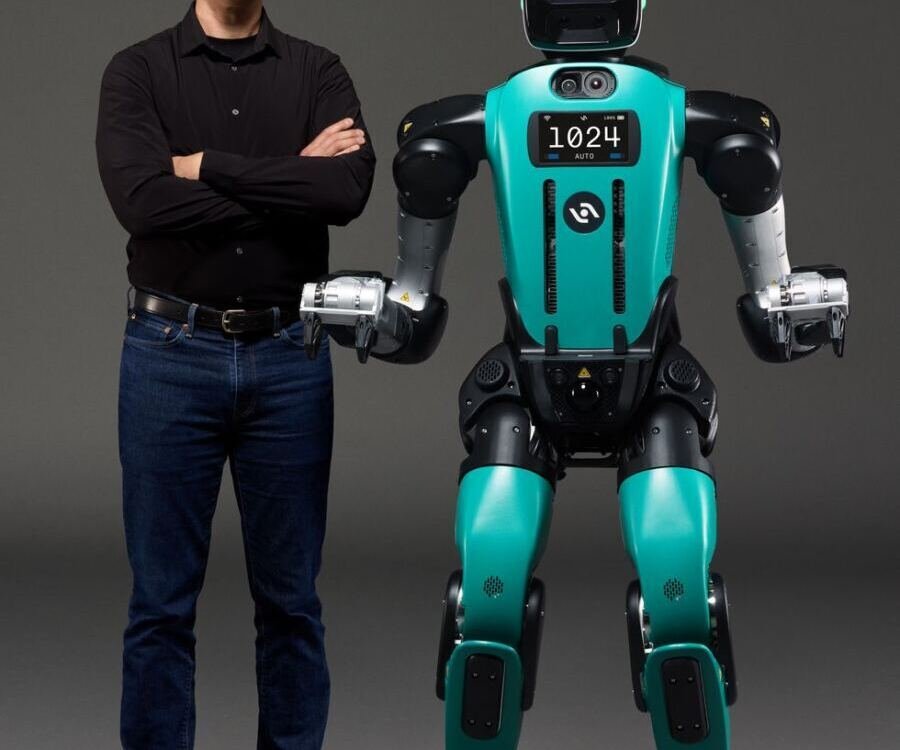
figure — agility Robotics’ first practical robotic worker is nothing like I dreamed Author and Agility Robotics co-founder Jonathan Hurst next to his new Digit 5 humanoid robot worker. Agility Robotics, the company I cofounded out of my robotics lab at Oregon State University in 2015, has just launched Digit 5.
It’s designed to be the first humanoid robot that can safely and economically do useful work at scale, allowing us to bring tens of thousands of humanoid workers into the real world. Engineered to lift 23-kilogram bins onto high shelves and with a battery that can run for 90 minutes on a 9-minute charge, Digit 5’s goal is to handle heavy warehouse tasks shift after shift, filling the need for labor in jobs that are too physically stressful or too dull for humans to want to do. Digit 5 is what Agility has been working toward for over a decade. But the robot is heavy and bulky, lacking the graceful natural motion of its predecessors, and it’s farther than I thought possible from the robot I dreamed of building when I started this company. To deliver a useful commercial product, Agility has taken a path that is very different from what I first imagined. My dream has always been to build robots that combine locomotion and manipulation to move through the world and interact with it as people do. I seek a mastery of motion, achieved through devices designed to navigate the constraints of physics with elegance. When I started the Dynamic Robotics Laboratory at Oregon State in 2008, we began with a theory derived from decades of work in biomechanics: that a simple “spring-mass” model (a body supported by legs that act like springs) should be able to reproduce every known walking and running gait found in animals. We put theory into practice by building the bipedal robot ATRIAS—short for “Assume The Robot Is A Sphere,” a joke among physicists about reducing a complex system to its simplest possible form. ATRIAS looked like a large microwave on stilts because it was only intended to demonstrate the physics of human walking and running. This was the first glimmer of achieving my dream; even though ATRIAS wasn’t designed to look like us, it still seemed natural, and even somehow alive, when it settled into a walking gait. With the success of ATRIAS, the barriers to progress shifted from scientific to engineering and organizational, and a startup company seemed like the way to bridge the gap from a one-off research concept to an actual robotic product. I felt confident of two things: that I would be able to build robots that could go where people go, and that this capability would be incredibly useful. This combination of ambition and naivete is necessary for anyone to found a new company—how hard could it be? Good advice for starting a company is to understand a customer problem, and then find a way to solve it using your unique capabilities.