PP-OCRv6 on Hugging Face: 50-Language OCR from 1.5M to 34.5M Parameters
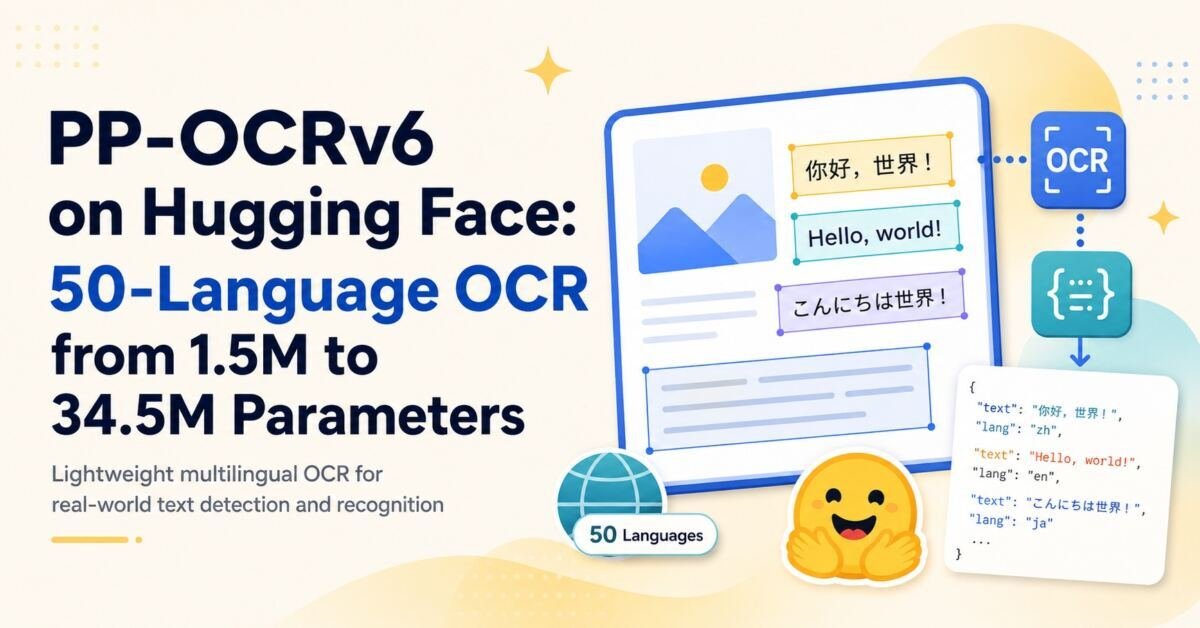
PP-OCRv6 on Hugging Face: 50-Language OCR from 1.5M to 34.5M Parameters
It is designed for real-world text detection and recognition across documents, screenshots, multilingual images, digital displays, industrial labels, and scene text. The model family scales from 1.5M to 34.5M parameters, with three tiers: tiny, small, and medium. The medium and small tiers support 50 languages, including Simplified Chinese, Traditional Chinese, English, Japanese, and 46 Latin-script languages. Try PP-OCRv6 online quickly: PP-OCRv6 Online Demo. On PaddleOCR’s official in-house multi-scenario OCR benchmarks, PP-OCRv6_medium reaches 86.2% detection Hmean and 83.2% recognition accuracy. Compared with PP-OCRv5_server, it improves text detection by +4.6 percentage points and text recognition by +5.1 percentage points. PP-OCRv6 focuses on a practical OCR need: producing accurate, structured text outputs with small models and flexible deployment options. For a deeper discussion of why specialized OCR models remain useful in the VLM era, see our previous blog: PP-OCRv5 on Hugging Face: A Specialized Approach to OCR. PP-OCRv6 introduces architecture, training, and data improvements across detection and recognition. The main design goal is to improve OCR accuracy while keeping model sizes suitable for different deployment settings. PP-OCRv6 provides three model tiers, covering different model sizes and OCR accuracy levels. PP-OCRv6 uses PPLCNetV4 as a unified backbone for text detection and text recognition. For developers, the main benefit is consistency across the model family. The tiny, small, and medium tiers are not unrelated models; they are part of the same OCR family and share a common architectural direction. Text detection is the first stage of the OCR pipeline.