Can AI agents program industrial robots without training data? Berkeley says yes
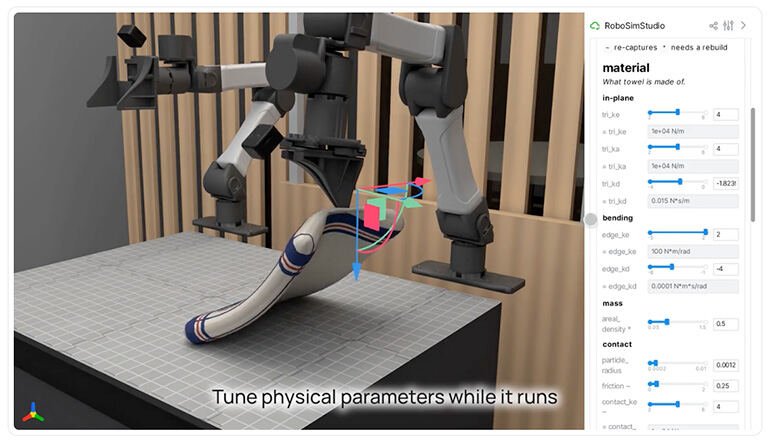
NVIDIA Corp. — the new RoboSimStudio is an open-source project that enables agentic AI coding of robotic simulation environments. | Since the early days of industrial robots, programming, tuning, and troubleshooting robotic workcells has taken weeks to months.
New research coming out of UC Berkeley has demonstrated that new agentic AI programming tools could change how industrial robots are coded and maintained. Why is this important? As anyone who’s programmed an industrial workcell knows, implementing the code has to wait until the end of the design and fabrication process. The robot needs to be installed in the workcell; all of the feeders, conveyance, and other elements also need to be installed. The pressure to get this done all falls on the software team, often when the project deadline is looming. The new toolset goes beyond the idea of “vibe coding” a robot application. While it generates code with large language models (LLMs), what’s novel is the use of AI agents to manage the coding, testing and deployment. “Agentic robotics is a fundamental shift in how robots are programmed,” said Ken Goldberg, the William S. Floyd Jr. Distinguished Chair in Engineering at UC Berkeley. “Instead of collecting massive amounts of data and hand-tuning every behavior, teams of agents can quickly generate, test, and refine robot programs that allow human engineers to interpret how the programs work for fine-tuning and verification.” Researchers introduce GaP and VABAR Graph-as-Policy (GaP) is a modular framework that splits a task into skills — perception, grasp planning, collision-free motion — which agents generate, connect and rehearse in simulation. Variational Automation Benchmark for Agentic Robotics (VABAR) is a benchmark of six tasks: tool sorting, tool hanging, gear meshing, syringe packing, cable insertion, and cable routing. It is built built on Isaac Lab-Arena and Newton, with standardized variations and difficulty tiers. The UC Berkeley and NVIDIA team presented the concept at CoRL 2026 this week in Austin, Texas. How the toolset works Dr.