Building the enterprise environment for agentic AI
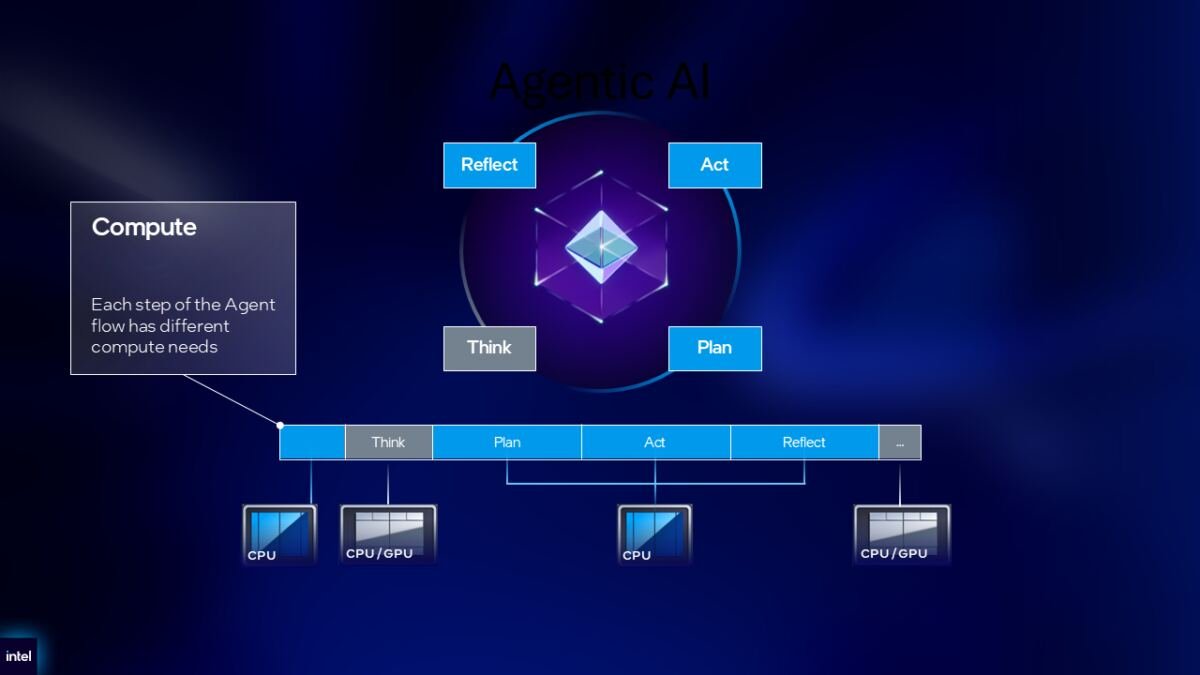
figure — for the enterprise, the promise of agentic AI is much more than just a better chatbot. It is software agents that execute business tasks end-to-end across people, business workflows, data, and systems.
The platform best-suited to run agents is built with proper CPU capacity, resilient data access, policy-aware tool use, observability, memory management, and the ability to predictably plan and scale agents. To better understand some of these dependencies, Intel performed thousands of agentic AI workload experiments. Our initial findings create and support five practical lessons for enterprise leaders: Agentic AI is a larger systems problem, not just one of inference. The majority of existing agentic AI harnesses are limited and do not measure overall system performance. Plan capacity is done using agents per virtual CPU (vCPU) density, not agent count. Monitor agent task latency, not just average CPU utilization. Default to scale-out for systems hosting agents. Reserve scale-up for workloads with heavier per-agent compute or architectural constraints. Beyond inference: Agents as workflow automation Agentic AI is more than LLM inference. Its enterprise value depends on the full system, task orchestration, data access, tool execution, latency management, governance, and scalable infrastructure. An agent is a goal-driven automated enterprise workflow process: It plans a multi-step task, calls tools, reads results, and retries when something fails. Enterprise agents are therefore not just an inference problem; they are a systems problem. Defining what good looks like Most agentic AI metrics focus on evaluating the LLM used. Platform teams also need to know how long the tasks take, how many agents a fleet can support, what users experience at the end of the execution process, and how costs change as more agents work simultaneously. A more useful enterprise view looks at six metrics: Task success rate Cost per task Time per task Task throughput Agent density (agents per vCPU) Latency Together, these answer the questions enterprise AI operators care about: Is the system performing as expected?