How GlobalLogic helped Haystack Robotics build a UV disinfection robot
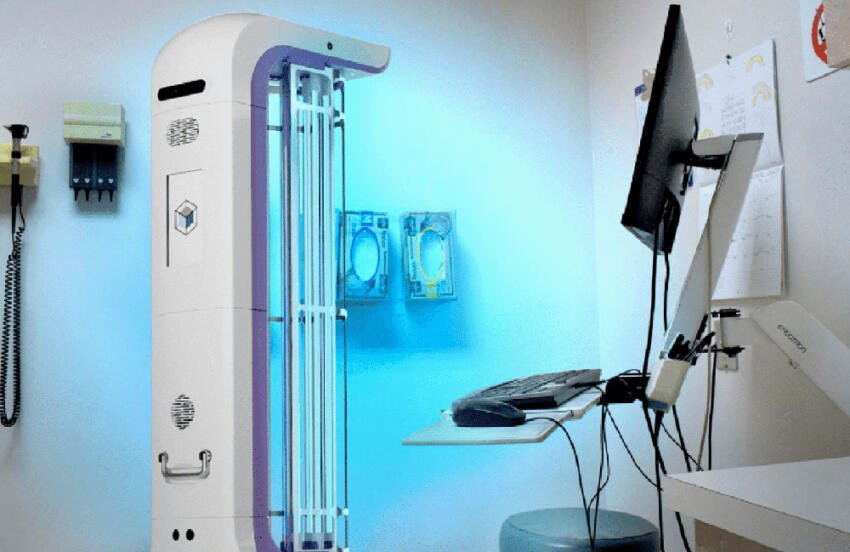
GlobalLogic developed the UV disinfection robot with Haystack Robotics. | But the cleaning process, which is time-intensive and difficult to scale, remains manual work.
This often means the process is also inconsistent. Healthcare facilities are under pressure to care for more patients with fewer resources. These challenges are why the Silicon & Embedded division at GlobalLogic helped Haystack Robotics engineer a mobile robot to handle disinfection. The project started during the COVID-19 pandemic, when disinfection became a critical use case for robots. “Obviously, this was a big use case at that point of time, in terms of being able to sanitize hospitals and care facilities,” Kunaal Mahanti, physical AI lead at GlobalLogic, told The Robot Report. “So [Haystack] came up with this concept of being able to do disinfection better.” “While there were disinfections which are happening manually, it wasn’t really good coverage,” he added. “We were really the engineering and collaboration partner there to see how we can take this concept and make it.” The result is an autonomous mobile robot (AMR) that combines real-time perception, edge-based intelligence, and navigation to deliver hospital-grade UV disinfection with minimal human intervention. The Santa Clara, Calif.-based company said it can operate safety alongside people, interpret its surroundings, and adapt to changes in its environment. GlobalLogic aims to create a scalable platform When designing its robot, Mahanti said GlobalLogic didn’t want to just quickly design a system for one use case or environment. “We wanted to make it an expandable platform,” he explained. “The idea was that you can look at, for example, the track part of it, which is the thing that is carrying the robot, independent of what it is carrying, which is the UV. Architecturally, you keep them separated so that we can mount other things at a later date.” “It went from a concept to what would be an architectural foundation, so that it’s not just that one product,” said Mahanti. “It actually becomes a class of solutions that we can build for the same industry segment.” While GlobalLogic hasn’t done many other deployments in hospitals, Mahanti did say the company used some of the base components of the UV robot for other projects. “When you look at the platform that moves, there are things that have come out from there in terms of the control of the motors,” he said. “Then we use ROS to do the programming and the sensor fusion part, that is reusable, and we’ve used that.