LiberAI Unveils Liber-0, a World Action Model That Grounds Human Experience in Robot Action
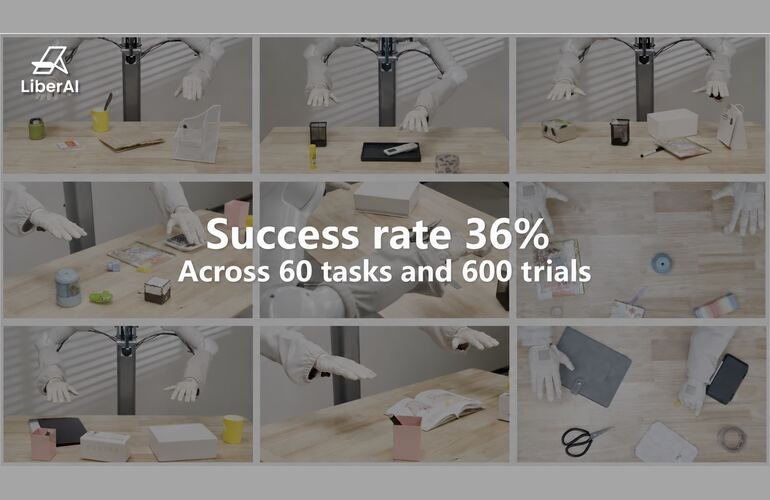
LiberAI introduces Liber-0, a world action model pretrained on more than 2.2 million hours of human experience to support zero-shot robot manipulation. In an evaluation of 60 tasks proposed by GPT-6, it achieved 36.0% overall success without robot demonstrations collected specifically for those target tasks.
The model combines large-scale human video, glove-recorded hand motion and embodiment alignment to transfer human manipulation experience to robots. Liber-0 achieves 36.0% overall success in a zero-shot evaluation of 60 tasks proposed by GPT-6. LiberAI has introduced Liber-0, a world action model (WAM) pretrained on more than 2.2 million hours of human experience. The Beijing-based startup said the model combines human video with glove-recorded motion and embodiment-conditioned learning to transfer human manipulation experience to robots. A central test of Liber-0’s generalization is whether it can perform target tasks without robot demonstrations collected specifically for them. LiberAI evaluated the model on a separate suite of 60 GPT-6-proposed tasks, distinct from its internal scaling benchmarks: 20 pick-and-place (PnP) tasks, 20 non-PnP manipulation tasks, and 20 challenging non-PnP and long-horizon tasks. Examples from the suite include placing a pen in a pencil case, pushing a drawer closed, and a longer sequence in which a pen is placed in a pouch and the pouch is stored in a drawer. LiberAI reported task success rates of 63.5% on pick-and-place tasks, 34.0% on non-pick-and-place manipulation tasks and 10.5% on challenging non-pick-and-place and long-horizon tasks, with an overall success rate of 36.0% across 600 trials. Here, zero-shot means the evaluated checkpoint was not trained on robot demonstrations collected specifically for these target tasks; pretraining still included robot data. Why learn from people? Robot manipulation has traditionally relied heavily on demonstrations recorded on a specific robot for a specific task, usually by a human operator teleoperating the machine. That data closely matches deployment, but collecting it can be slow and expensive, particularly when new tasks or robot platforms require additional demonstrations. Human activity is far more abundant, and much of it is already on video. The obstacle, according to LiberAI, is that human video does not translate directly into robot commands. Cameras sit in different places, hand poses estimated from video are noisy, and human bodies move differently from robots.