The State of Simulation for Physical AI: An Overview
Hugging Face why Simulation Which Simulation Engine Should I Use? MuJoCo MuJoCo Warp Isaac Sim Isaac Lab How Isaac Lab 3.0 Relates to Isaac Sim and Newton Modern GPU-Accelerated Physics for Robotics Newton Other Simulation Engines Conclusion Why Simulation Figure 1: Humanoid robot locomotion simulation.
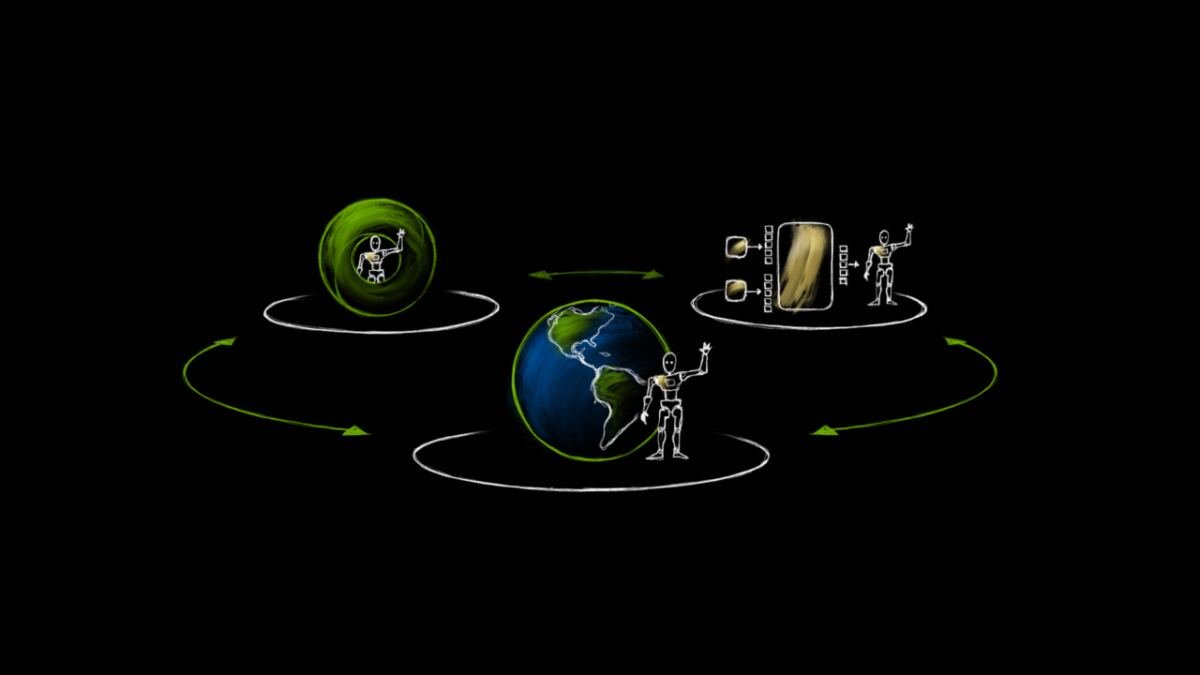
The robot’s pose is represented by tracked body keypoints (green markers), while successive robot instances illustrate its movement through time. Directional arrows indicate commanded motion, demonstrating the use of a physics-based simulation environment for training and evaluating robot locomotion and control policies. The primary challenge in building physical AI systems is data availability. Large language models (LLMs) and vision-language models (VLMs) can be trained on internet-scale datasets, but robotics and physical AI systems do not have the same advantage. To train a physical AI system, a robot must learn the consequences of interacting with the physical world. For example, it needs to understand what happens when a cup slips, a cable bends, or a gripper contacts an object at the wrong angle. Collecting this kind of data in the real world is slow, expensive, risky, and sometimes impractical due to the destructive nature of the tasks. Simulation provides a bridge by enabling developers to generate large amounts of photorealistic, physically grounded data. By teleoperating robots in simulation and scaling data collection through GPU parallelism, developers can generate thousands of hours of robot experience at a fraction of the cost of real-world collection. Earlier robotics simulators were often used primarily to debug geometry, test controllers, or visualize robot motion. Today, simulation has become part of the model development loop. Teams use it to generate perception datasets, train reinforcement learning policies, collect demonstrations, augment real-world data, benchmark models, and test policies against rare or adversarial scenarios. This shift is why industrial research labs and academic groups are increasingly contributing to, or developing, simulation engines that can meet these new requirements. These requirements can be understood through a three-computer paradigm: Figure 2: A physical system (Earth and robot) continuously exchanges data with its virtual representation (digital model), enabling monitoring, analysis, prediction, and control through a bidirectional feedback loop. Each computer plays a different role depending on the task’s latency, throughput, accuracy, and deployment requirements.