Tickets, geofences, and 1M miles: The new reality of California AV compliance
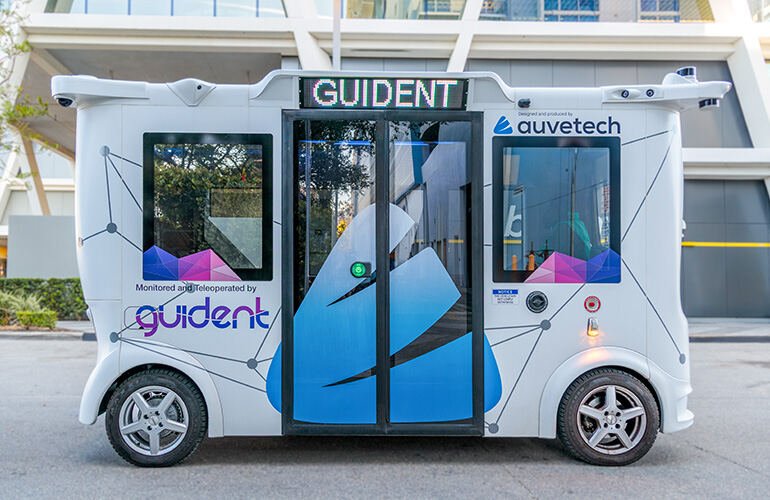
Guident is operating an AuveTech shuttle in South Florida, managing a four-mile route in West Palm Beach and a one-mile route in Boca Raton with its remote monitoring technology. | Harold Braun, executive chairman and CEO of Guident, spoke with The Robot Report about the state’s massive regulatory shift, its expansion into autonomous heavy freight, and how advanced remote monitoring and control systems are becoming the ultimate linchpin for compliance.
“From what California did, it shows very clearly that California is continuing to lead the way in autonomous vehicle technology deployment,” he stated. “What happened in California at the moment is very important, is a game changer, because it opens the pathway to not only testing in a geo-fenced area, but also allowing it to happen right on a public road…. And that, of course, has implications for the developers.” Braun noted that autonomous vehicles (AVs) have clear regulatory requirements, and the safety of AVs around the general public is paramount in every region where AVs are currently being deployed. Self-driving cars and trucks carry tremendous risk to unsuspecting drivers, cyclists, and pedestrians, he acknowledged. Therefore, the government regulates when and where AVs can be on public roads. In addition, new regulations are emerging to help guide AV developers while providing the legal framework for continued development. Federal oversight of AVs is split across three distinct vehicle classes, each governed by specific regulatory frameworks: Purpose-built AVs: These are “pure” autonomous vehicles engineered from the ground up with no steering wheels, pedals, or onboard human driver controls. This class is regulated directly by the National Highway Traffic Safety Administration (NHTSA). Consumer passenger vehicles: Ranging from everyday Subarus to luxury Jaguars, these vehicles feature traditional driver seats and manual controls. They can be equipped with drive-by-wire systems—either factory-installed or as aftermarket modifications—and must comply with the Federal Motor Vehicle Safety Standards (FMVSS), which are also maintained by NHTSA. Commercial vehicles: This sector covers light and heavy trucks, including tractor-trailers, which are frequently retrofitted with aftermarket autonomous driving technology. Because of their commercial application, these vehicles fall under the jurisdiction of the Federal Motor Carrier Safety Administration (FMCSA). California leads the way with state AV regulations California and Florida are both working with the autonomous vehicle industry on regulations to protect the public while enabling technology companies to safely test, validate, and improve their solutions. Recent regulations in California now provide a framework for the deployment of AVs, including heavy trucks, outside of geofenced areas and onto public roads, next to and interacting with the public. According to Braun, “that [public deployment] comes with certain accountabilities and also with certain regulations, and these are very clearly described in that [new] law.